
|
You entered: disk
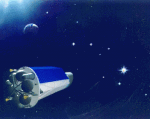 Searching For Solar Systems
14.11.1996
Observational astronomy has recently provided evidence of the existence of massive Jupiter-sized planets orbiting distant suns, protoplanetary disks of gas and dust surrounding newly formed stars, and planetary bodies orbiting exotic stellar corpses known as pulsars. Indeed, the formation of planets seems to be a broader and more varied phenomenon than previously imagined.
 A Rare Hybrid Solar Eclipse
3.11.2013
A spectacular geocentric celestial event of 2005 was a rare hybrid eclipse of the Sun - a total or an annular eclipse could be seen depending on the observer's location. For Fred Espenak, aboard...
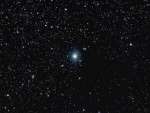 The Mystery of the Fading Star
7.01.2010
Every 27 years Epsilon Aurigae fades, remaining dim for roughly two years before growing bright again. Since the 19th century, astronomers have studied the mystery star, eventually arguing that Epsilon Aur, centered in this telescopic skyview, was actually undergoing a long eclipse by a dark companion object.
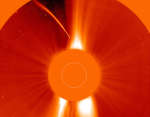 Sungrazer
27.10.2013
Arcing toward a fiery fate, this Sungrazer comet was recorded by the SOHO spacecraft's Large Angle Spectrometric COronagraph(LASCO) on December 23, 1996. LASCO uses an occulting disk, partially visible at the lower...
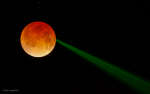 Red Moon, Green Beam
18.04.2014
This is not a scene from a sci-fi special effects movie. The green beam of light and red lunar disk are real enough, captured in the early morning hours of April 15. Of course, the reddened lunar disk is easy to explain as the image was taken during this week's total lunar eclipse.
 September s Harvest Moon
16.09.2011
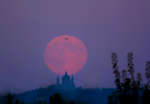
A Full Moon rising can be a dramatic celestial sight, and Full Moons can have many names. For example, Monday's Full Moon was the one nearest this year's autumnal equinox for the northern hemisphere, traditionally called the Harvest Moon.
 Orion: The Big Picture
30.11.1997
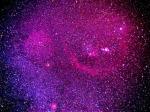
Orion is big. Some of the stars that form the constellation of Orion are part of a giant gas cloud complex that stretches over 100 light years and appears more than 50 times the diameter of the Moon.
 A Stereo Sun
25.11.2005
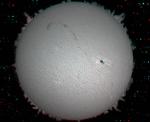
A stereo view of the closest star, this creatively composited image was constructed from an extensive archive of pictures taken between March 2004 and April 2005. When viewed with red/blue glasses, the Sun's disk and surface features, including sunspots, filaments, and prominences, stand out in an exaggerated stereo perspective.
 Moonset Eclipse
31.01.2018
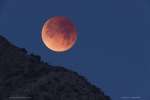
Near the closest point in its orbit, the second Full Moon of the month occurred on January 31. So did the first Total Lunar Eclipse of 2018, as the Moon slid through planet Earth's shadow.
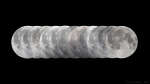 An Almost Eclipse of the Moon
17.01.2020
This composited series of images follows the Moon on January 10, the first Full Moon of 2020, in Hungarian skies. The lunar disk is in mid-eclipse at the center of the sequence though. It looks only slightly darker there as it passes through the light outer shadow or penumbra of planet Earth.
|
January February March April May June July August September October November |
||||||||||||||||||||||||||||||||||||||||||||||||||||||||