
|
You entered: apollo
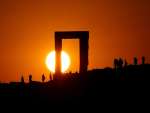 Sunset at the Portara
19.03.2009
Today, the Sun crosses the celestial equator heading north at 11:44 UT. Known as an equinox, this astronomical event marks the first day of spring in the northern hemisphere and autumn in the south. It also marks the beginning of Norouz, the Persian (Iranian) new year. Equinox means equal night.
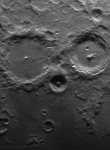 Alphonsus and Arzachel
16.07.2021
Point your telescope at tonight's first quarter Moon. Along the terminator, the shadow line between night and day, you might find these two large craters staring back at you with an owlish gaze. Alphonsus (left) and Arzachel are ancient impact craters on the north eastern shores of Mare Nubium, the lunar Sea of Clouds.
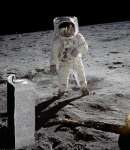 Evidence Mounts for Water on the Moon
1.04.2010
In 2009, space missions revealed tantalizing signs of water on or near the lunar surface, once thought of as a dry and desolate environment. But researchers are now offering this archival picture as further evidence that humans might one day be able to use the Moon's newly discovered resource to directly quench their thirst.
 Miass River Sunrise
2.03.2013
Each day on planet Earth can have a serene beginning at sunrise as the sky gently grows bright over a golden eastern horizon. This sunrise panorama seems to show such a moment on the winter morning of February 15.
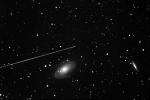 Asteroid and Galaxy
5.04.2007
Apollo class asteroid 2006 VV2 flashed past planet Earth in late March, approaching to within 3.4 million kilometers or about 8.8 times the Earth-Moon distance. Due to the proximity of its orbit to Earth and its estimated diameter of over 1 kilometer, 2006 VV2 is classified as a Potentially Hazardous Asteroid.
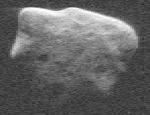 1999 JM8: A Rock Too Close
1.09.1999
Nearly four kilometers across, the huge rock known as 1999 JM8 silently passed only 8.5 million kilometers from the Earth in early August. The small asteroid was completely unknown before May. Every few centuries, a rock like this impacts the Earth, with the potential to disrupt modern civilization.
 Biking to the Moon
1.10.2020
As you watched October's first Full Moon rise last night, the Full Moon closest to the northern autumnal equinox, you were probably asking yourself, "How long would it take to bike...
 To the Moon
23.02.2024
Intuitive Machines' robotic lander Odysseus has accomplished the first U.S. landing on the Moon since the Apollo 17 mission in 1972. Launched on a SpaceX rocket on February 15, the phone booth sized lander reached lunar orbit on the 21st and touched down on the lunar surface at 6:23 pm ET on February 22nd.
 Liftoff! Returning to the Moon
1.04.2026
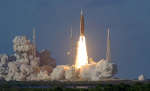
We are one small step closer to returning to the Moon. A new chapter in human exploration began yesterday when NASA's Artemis II launched aboard the Space Launch System (SLS) from Kennedy Space Center. Carrying four astronauts, the Orion spacecraft's planned lunar flyby will be the first in over half a century.
 A Colorful Moon
19.12.2013
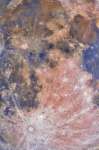
The Moon is normally seen in subtle shades of grey or yellow. But small, measurable color differences have been greatly exaggerated to make this telescopic, multicolored, moonscape captured during the Moon's full phase. The different colors are recognized to correspond to real differences in the chemical makeup of the lunar surface.
|
January February March April May June July August September |
|||||||||||||||||||||||||||||||||||||||||||||||||