
|
You entered: orbit
 Equinox at Saturn
25.08.2009
What would Saturn's rings look like if the ring plane pointed directly at the Sun? That situation occurred earlier this month when equinox occurred on Saturn. Since the Earth is nearly in the same direction as the Sun from Saturn, the rings appeared to disappear from Earth.
 HD 10180: Richest Yet Planetary System Discovered
25.08.2010
Do other rich planetary systems exist? Our Solar System has the most planets of any known star, most probably because it is so hard to detect planets around other stars. Sensitive measurements, though, have...
 Superstorm Sandy From Formation to Landfall
7.11.2012
It was the largest hurricane ever recorded in the Atlantic Ocean. The cost of its devastation is still unknown. Pictured above is a movie of Superstorm Sandy taken by the Earth-orbiting GOES-13 satellite over...
 Polar Ring Galaxy NGC 660
10.11.2012
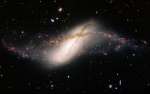
NGC 660 is featured in this cosmic snapshot, a sharp composite of broad and narrow band filter image data from the Gemini North telescope on Mauna Kea. Over 20 million light-years away and swimming within the boundaries of the constellation Pisces, NGC 660's peculiar appearance marks it as a polar ring galaxy.
 Polar Ring Galaxy NGC 660
7.11.2014
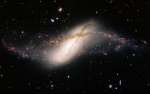
NGC 660 is featured in this cosmic snapshot, a sharp composite of broad and narrow band filter image data from the Gemini North telescope on Mauna Kea. Over 20 million light-years away and swimming within the boundaries of the constellation Pisces, NGC 660's peculiar appearance marks it as a polar ring galaxy.
 APOD: 2024 May 28 Б Solar X Flare as Famous Active Region Returns
28.05.2024
It's back. The famous active region on the Sun that created auroras visible around the Earth earlier this month has survived its rotation around the far side of the Sun -- and returned. Yesterday...
 A High Energy Fleet
25.11.2000
Like a fleet of futuristic starcruisers, NASA's highly successful series of High Energy Astrophysical Observatory (HEAO) spacecraft appear poised over planet Earth. Labeled A, B, and C in this vintage illustration, the spacebased telescopes were known as HEAO-1, HEAO-2, and HEAO-3 respectively.
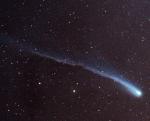 Comet Ikeya Zhang Brightens
7.03.2002
In the last week, Comet Ikeya-Zhang has become bright enough to be just visible to the unaided eye. Based on its present activity, observers are optimistic that Ikeya-Zhang will become substantially brighter. This composite...
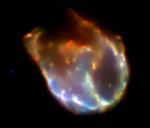 N132D and the Color of X Rays
23.05.2002
Supernova remnant N132D shows off complex structures in this sharp, color x-ray image. Still, overall this cosmic debris from a massive star's explosive death has a strikingly simple horseshoe shape. While N132D lies 180,000 light-years distant in the Large Magellanic Cloud, the expanding remnant appears here about 80 light-years across.
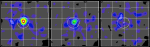 Afterglow
28.05.1998
This sequence of three false color X-ray pictures from the Italian/Dutch BeppoSAX satellite follows the fading glow from a gamma-ray burster. This burster triggered orbiting gamma-ray observatories on December 14, 1997 and within 6.5 hours the sensitive X-ray cameras onboard BeppoSAX had been turned to record the first image (left) of the afterglow.
|
January February March April May June July August September |
|||||||||||||||||||||||||||||||||||||||||||||||||