
|
You entered: color
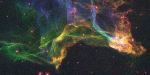 Cygnus Loop Supernova Shockwave
18.07.1995
15,000 years ago a star in the constellation of Cygnus exploded. This picture shows a portion of a shockwave from this supernova explosion still expanding past nearby stars. The collision of this gaseous...
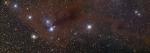 Stars and Dust Across Corona Australis
3.04.2006
A cosmic dust cloud sprawls across a rich field of stars in this gorgeous wide field telescopic vista looking toward Corona Australis, the Southern Crown. Probably less than 500 light-years away and effectively blocking...
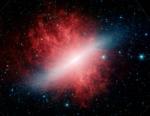 Smoke from the Cigar Galaxy
14.04.2006
Very bright in infrared light, well-known starburst galaxy M82's popular name describes its suggestive shape seen at visible wavelengths - The Cigar Galaxy. Ironically, M82's fantastic appearance in this Spitzer Space Telescope image...
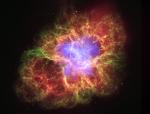 Composite Crab
26.10.2006
The Crab Nebula is cataloged as M1, the first object on Charles Messier's famous list of things which are not comets. In fact, the Crab is now known to be a supernova remnant, expanding debris from the death explosion of a massive star.
 APOD: 2025 April 28 Б Gum 37 and the Southern Tadpoles
28.04.2025
This cosmic skyscape features glowing gas and dark dust clouds alongside the young stars of NGC 3572. A beautiful emission nebula and star cluster, it sails far southern skies within the nautical constellation Carina.
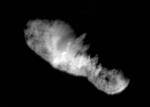 Comet Borrelly's Nucleus
26.09.2001
What does a comet nucleus look like? To answer this question, NASA controllers drove an aging probe through the hostile environs of a distant comet, expecting that even if comet fragments disabled the spacecraft, it would be worth the risk. The probe, Deep Space 1, survived.
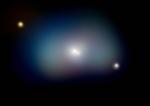 NGC 1700: Elliptical Galaxy and Rotating Disk
16.01.2003
In spiral galaxies, majestic winding arms of young stars and interstellar gas and dust rotate in a disk around a bulging galactic nucleus. Elliptical galaxies seem to be simpler, randomly swarming with old stars and lacking gas and dust.
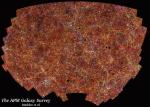 Two Million Galaxies
11.06.2003
Our universe is filled with galaxies. Galaxies -- huge conglomerations of stars, gas, dust -- and mysterious dark matter are the basic building blocks of the large-scale universe. Although distant galaxies move away from each other...
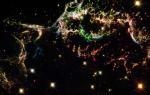 Recycling Cassiopeia A
30.08.2003
For billions of years, massive stars in our Milky Way Galaxy have lived spectacular lives. Collapsing from vast cosmic clouds, their nuclear furnaces ignite and create heavy elements in their cores. After a few million years, the enriched material is blasted back into interstellar space where star formation begins anew.
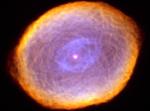 IC 418: The Spirograph Nebula
17.10.2004
What is creating the strange texture of IC 418? Dubbed the Spirograph Nebula for its resemblance to drawings from a cyclical drawing tool, planetary nebula IC 418 shows patterns that are not well understood. Perhaps they are related to chaotic winds from the variable central star, which changes brightness unpredictably in just a few hours.
|
January February March April May June July August |
||||||||||||||||||||||||||||||||||||||||||||||||||||||||