
|
You entered: NASA
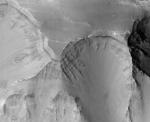 In A Grand Canyon On Mars
11.02.1998
In a grand canyon on Mars, steep slopes fall away from a smooth plateau revealing striking layered rock formations. The canyon is part of the Valles Marineris, a 2,500 mile long system of canyons cutting across the Martian equator.
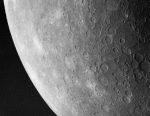 Southwest Mercury
13.09.1996
The planet Mercury resembles a moon. Mercury's old surface is heavily cratered like many moons. Mercury is larger than most moons but smaller than Jupiter's moon Ganymede and Saturn's moon Titan. Mercury is much denser and more massive than any moon, though, because it is made mostly of iron.
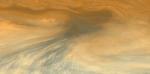 Jupiter's Dry Spots
12.06.1997
Known for its spectacular images of Jupiter's moons, Io, Ganymede, Callisto, and Europa, the robot spacecraft Galileo has also aggressively explored the Jovian atmosphere. In December of 1995, Galileo's atmospheric probe descended into Jupiter's clouds and reported a surprising absence of water.
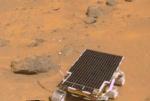 Barnacle Bill And Sojourner
8.07.1997
Deployed on a pop-up mast to its full height, the Sagan Memorial Station's IMP camera now stands about 5 feet above the surface of Ares Vallis - on Mars. This is one of the first images from its new vantage point, showing the rover Sojourner near a rock named Barnacle Bill.
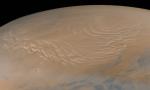 The North Pole Of Mars
24.09.1998
The North Pole of Mars is capped by layers likely consisting of ice and dust deposited over millions of years. Imaged on September 12 - early Spring for Northern Mars - by the Mars Global Surveyor's camera, this synthesized wide-angle color view shows the rippled, eroded polar terrain covered with pinkish seasonal carbon dioxide frost.
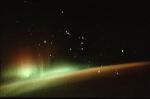 Aurora and Orion
19.03.1999
Looking toward the south from low Earth orbit, the crew of the Space Shuttle Endeavor made this stunning time exposure of the Aurora Australis or southern lights in April of 1994. Aurora are visible at high northern latitudes as well, with the northern lights known as Aurora Borealis.
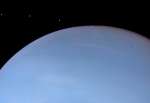 Despina, Moon of Neptune
3.09.2009
Despina is a tiny moon of Neptune. A mere 148 kilometers across, diminutive Despina was discovered in 1989, in images from the Voyager 2 spacecraft taken during its encounter with the solar system's most distant gas giant planet.
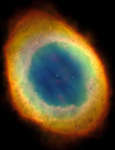 M57: The Ring Nebula
14.11.2009
It looks like a ring on the sky. Hundreds of years ago astronomers noticed a nebula with a most unusual shape. Now known as M57 or NGC 6720, the gas cloud became popularly known as the Ring Nebula.
 The First Color Panorama from Mars by Curiosity
11.08.2012
You've just landed on Mars and opened your eyes -- what do you see? If you're the Curiosity rover, you see a strange gravelly place with a large mountain in the distance.
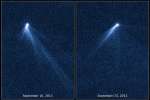 The Unexpected Tails of Asteroid P5
12.11.2013
What is happening to asteroid P/2013 P5? No one is sure. For reasons unknown, the asteroid is now sporting not one but six discernible tails. The above images were taken two months ago by the orbiting Hubble Space Telescope and show the rapidly changing dust streams.
|
January February March |
||||||||||||||||||||||||||||||||||||||||||||||||||||||||