
|
You entered: outer Galaxy
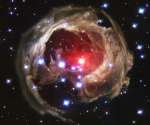 Light Echoes from V838 Mon
4.12.2011
For reasons unknown, star V838 Mon's outer surface suddenly greatly expanded with the result that it became the brightest star in the entire Milky Way Galaxy in January 2002. Then, just as suddenly, it faded. A stellar flash like this has never been seen before.
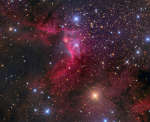 Sh2 155: The Cave Nebula
19.10.2013
This colorful skyscape features the dusty, reddish glow of Sharpless catalog emission region Sh2-155, the Cave Nebula. About 2,400 light-years away, the scene lies along the plane of our Milky Way Galaxy toward the royal northern constellation of Cepheus.
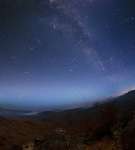 Lyrids in Southern Skies
24.04.2014
Earth's annual Lyrid meteor shower peaked before dawn on April 22nd, as our fair planet plowed through dust from the tail of long-period comet Thatcher. Even in the dry and dark Atacama desert along Chile's Pacific coast, light from a last quarter Moon made the night sky bright, washing out fainter meteor streaks.
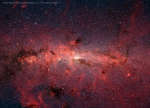 Stars at the Galactic Center
7.03.2015
The center of our Milky Way Galaxy is hidden from the prying eyes of optical telescopes by clouds of obscuring dust and gas. But in this stunning vista, the Spitzer Space Telescope's infrared cameras, penetrate much of the dust revealing the stars of the crowded galactic center region.
 Gamma ray Rain from 3C 279
22.07.2015
If gamma-rays were raindrops a flare from a supermassive black hole might look like this. Not so gently falling on the Fermi Gamma-ray Space Telescope from June 14 to June 16 the gamma-ray photons, with energies up to 50 billion electron volts, originated in active galaxy 3C 279 some 5 billion light-years away.
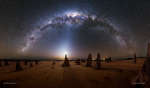 Milky Way over the Pinnacles in Australia
11.10.2020
What strange world is this? Earth. In the foreground of the featured image are the Pinnacles, unusual rock spires in Nambung National Park in Western Australia. Made of ancient sea shells (limestone), how these human-sized picturesque spires formed remains unknown.
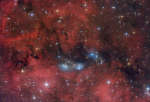 The NGC 6914 Complex
7.07.2022
A study in contrasts, this colorful skyscape features stars, dust, and glowing gas in the vicinity of NGC 6914. The interstellar complex of nebulae lies some 6,000 light-years away, toward the high-flying northern constellation Cygnus and the plane of our Milky Way Galaxy.
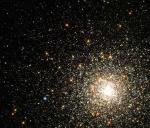 M80: A Dense Globular Cluster
7.07.1999
If our Sun were part of M80, the night sky would glow like a jewel box of bright stars. M80, also known as NGC 6093, is one of about 250 globular clusters that survive in our Galaxy.
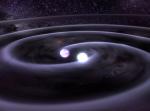 White Dwarf Star Spiral
1.06.2005
About 1,600 light-years away, in a binary star system fondly known as J0806, two dense white dwarf stars orbit each other once every 321 seconds. Interpreting x-ray data from the Chandra Observatory astronomers argue that the stars' already impressively short orbital period is steadily getting shorter as the stars spiral closer together.
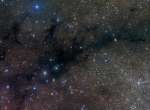 LDN 988 and Friends
24.09.2015
Stars are forming in dark, dusty molecular cloud LDN 988. Seen near picture center some 2,000 light-years distant, LDN 988 and other nearby dark nebulae were cataloged by Beverly T. Lynds in 1962 using Palomar Observatory Sky Survey plates.
|
January February March April May June July August September |
|||||||||||||||||||||||||||||||||||||||||||||||||