
|
You entered: star cluster
 Cluster and Starforming Region Westerlund 2
25.04.2015
Located 20,000 light-years away in the constellation Carina, the young cluster and starforming region Westerlund 2 fills this cosmic scene. Captured with Hubble's cameras in near-infrared and visible light, the stunning image is a celebration of the 25th anniversary of the launch of the Hubble Space Telescope on April 24, 1990.
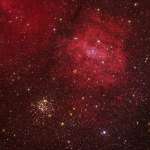 The Bubble and M52
30.10.2009
To the eye, this cosmic composition nicely balances the Bubble Nebula at the upper right with open star cluster M52. The pair would be lopsided on other scales, though. Embedded in a complex...
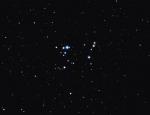 The 37 Cluster
18.11.2005
For the mostly harmless denizens of planet Earth, the brighter stars of open cluster NGC 2169 seem to form a cosmic 37. (Did you expect 42?.) Of course, the improbable numerical asterism appears solely by chance and lies at an estimated distance of 3,600 light-years toward the constellation Orion.
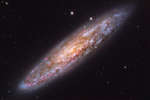 NGC 253: Dusty Island Universe
6.11.2025
Shiny NGC 253 is one of the brightest spiral galaxies visible, and also one of the dustiest. Some call it the Silver Coin Galaxy for its appearance in small telescopes, or just the Sculptor Galaxy for its location within the boundaries of the southern constellation Sculptor.
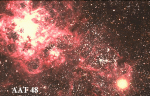 The Tarantula and the Supernova
27.10.1995
In this close-up of the Large Magellanic Cloud, the spidery looking nebula on the left is fittingly known as as the Tarantula nebula. It is an emission nebula surrounding a cluster of hot, young stars called the 30 Doradus super cluster.
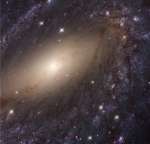 NGC 6744 Close Up
31.05.2018
Beautiful spiral galaxy NGC 6744 is nearly 175,000 light-years across, larger than our own Milky Way. It lies some 30 million light-years distant in the southern constellation Pavo, its galactic disk tilted towards our line of sight.
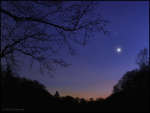 Venus in the West
11.04.2015
In the coming days, Venus shines near the western horizon at sunset. To find Earth's sister planet in twilight skies just look for the brilliant evening star. Tonight very close to the Pleiades...
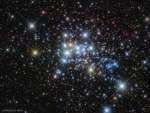 The Massive Stars in Westerlund 1
20.06.2017
Star cluster Westerlund 1 is home to some of the largest and most massive stars known. It is headlined by the star Westerlund 1-26, a red supergiant star so big that if placed in the center of our Solar System, it would extend out past the orbit of Jupiter.
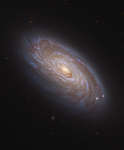 Messier 88
28.12.2022
Charles Messier described the 88th entry in his 18th century catalog of Nebulae and Star Clusters as a spiral nebula without stars. Of course the gorgeous M88 is now understood to be a galaxy full of stars, gas, and dust, not unlike our own Milky Way.
 The 37 Cluster
14.05.2024
For the mostly harmless denizens of planet Earth, the brighter stars of open cluster NGC 2169 seem to form a cosmic 37. Did you expect 42? From our perspective, the improbable numerical asterism appears solely by chance. It lies at an estimated distance of 3,300 light-years toward the constellation Orion.
|
January February March April May June July August September |
|||||||||||||||||||||||||||||||||||||||||||||||||