
|
You entered: hot star
 Regulus and the Dwarf Galaxy
26.04.2024
In northern hemisphere spring, bright star Regulus is easy to spot above the eastern horizon. The alpha star of the constellation Leo, Regulus is the spiky star centered in this telescopic field of view.
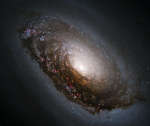 M64: The Sleeping Beauty Galaxy
12.06.2011
The Sleeping Beauty galaxy may appear peaceful at first sight but it is actually tossing and turning. In an unexpected twist, recent observations have shown that the gas in the outer regions of this photogenic spiral is rotating in the opposite direction from all of the stars!
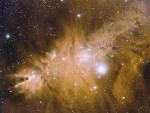 In the Vicinity of the Cone Nebula
12.05.2003
Strange shapes and textures can be found in neighborhood of the Cone Nebula. The unusual shapes originate from fine interstellar dust reacting in complex ways with the energetic light and hot gas being expelled by the young stars.
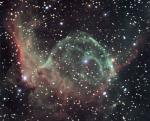 NGC 2359: Thor s Helmet
19.11.2005
(xxxedit and linkxxx) NGC 2359 is a striking emission nebula with an impressive popular name - Thor's Helmet. Sure, its suggestive winged appearance might lead some to refer to it as the "duck nebula", but if you were a nebula which name would you choose?
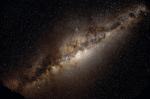 The Milky Way in Stars and Dust
4.10.2005
The disk of our Milky Way Galaxy is home to hot nebulae, cold dust, and billions of stars. This disk can be seen from a dark location on Earth as a band of diffuse light across the sky.
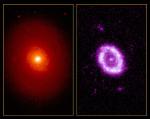 M94: Beyond the Blue
13.06.2001
Today's galaxy, M94 (NGC 4736), lies 15 million light-years away in the constellation Canes Venatici. In the red light image (left), its very bright nucleus and tightly wound spiral arms seem to slowly fade into a faint outer disk.
 In the Vicinity of the Cone Nebula
23.11.2008
Strange shapes and textures can be found in neighborhood of the Cone Nebula. The unusual shapes originate from fine interstellar dust reacting in complex ways with the energetic light and hot gas being expelled by the young stars.
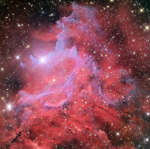 Flaming Star Nebula
1.12.2016
A runaway star lights the Flaming Star Nebula in this cosmic scene. Otherwise known as IC 405, the Flaming Star Nebula's billowing interstellar clouds of gas and dust lie about 1,500 light-years away toward the constellation of Auriga.
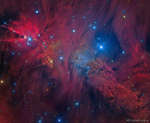 In the Vicinity of the Cone Nebula
16.04.2019
Strange shapes and textures can be found in neighborhood of the Cone Nebula. The unusual shapes originate from fine interstellar dust reacting in complex ways with the energetic light and hot gas being expelled by the young stars.
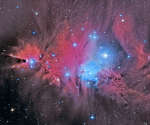 In the Vicinity of the Cone Nebula
13.12.2011
Strange shapes and textures can be found in neighborhood of the Cone Nebula. The unusual shapes originate from fine interstellar dust reacting in complex ways with the energetic light and hot gas being expelled by the young stars.
|
January February |
|||||||||||||||||||||||||||||||||||||||||||||||||