
|
You entered: galaxy center
 The Porpoise Galaxy from Hubble
10.05.2020
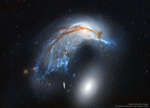
What's happening to this spiral galaxy? Just a few hundred million years ago, NGC 2936, the upper of the two large galaxies shown, was likely a normal spiral galaxy -- spinning, creating stars -- and minding its own business.
 The Porpoise Galaxy from Hubble
6.02.2017
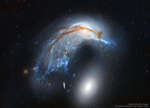
What's happening to this spiral galaxy? Just a few hundred million years ago, NGC 2936, the upper of the two large galaxies shown, was likely a normal spiral galaxy -- spinning, creating stars -- and minding its own business.
 Fornax Cluster in Motion
24.09.2004
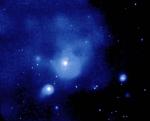
Reminiscent of popular images of the lovely Pleiades star cluster that lies within our own Milky Way Galaxy, this false-color x-ray view actually explores the center of a much more extended cosmic family -- the Fornax cluster of galaxies some 65 million light-years away.
 The Porpoise Galaxy from Hubble
24.06.2013
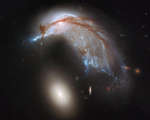
What's happening to this spiral galaxy? Just a few hundred million years ago, NGC 2936, the upper of the two large galaxies shown, was likely a normal spiral galaxy -- spinning, creating stars -- and minding its own business.
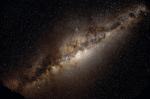 The Milky Way in Stars and Dust
4.10.2005
The disk of our Milky Way Galaxy is home to hot nebulae, cold dust, and billions of stars. This disk can be seen from a dark location on Earth as a band of diffuse light across the sky.
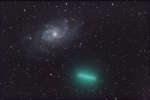 APOD: 2008 January 2- A Galaxy is not a Comet
2.01.2008
This gorgeous galaxy and comet portrait was recorded on December 30th, in the skies over Hoogeveen, The Netherlands. The combined series of 60 x 60 second exposures finds the lovely green coma of Comet 8P/Tuttle near its predicted conjunction with the Triangulum Galaxy.
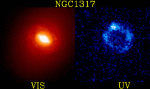 Starburst Ring in Galaxy NGC 1317
11.12.1996
Where do stars form? A typical place is an area of dense nebular gas common to arms in spiral galaxies. Sometimes, however, a burst of star formation can occur with unusual geometry. Nearby galaxy NGC 1317 shows such an unusual ring of star formation surrounding its barred nucleus.
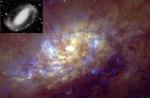 Starbirth in NGC 1808
23.03.1998
The center of galaxy NGC 1808 is bursting with new stars, but why? Being a barred spiral galaxy makes NGC 1808 somewhat similar to our own Milky Way Galaxy. But the disk of NGC 1808 (inset) is quite warped, and its center is unusually bright and blue.
 M51: The Center Of The Whirlpool
27.05.2000
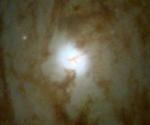
In the center of M51, a spiral galaxy 23 million light-years away, astronomers have identified a dense region of young stars. Viewed face-on in the constellation Canes Venatici, the swirling arcs of this galaxy's spiral arms have inspired its popular name, The Whirlpool Galaxy.
 The Near Infrared Sky
18.05.2000
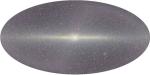
Was this picture taken from outside our Galaxy? No, it is a composite taken from Earth orbit, well inside our Milky Way Galaxy. In light just a little too red for human eyes...
|
January February March April May June July August |
||||||||||||||||||||||||||||||||||||||||||||||||||||||||