
|
You entered: corona
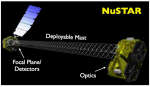 NuSTAR XRay Telescope Launched
19.06.2012
What's left after a star explodes? To help find out, NASA launched the Nuclear Spectroscopic Telescope Array (NuSTAR) satellite into Earth orbit last week. NuSTAR's ability to focus hard X-rays emitted from...
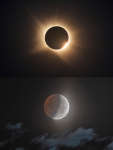 APOD: 2026 August 29 Б Eclipse Pair
28.08.2026
Eclipses tend to come in pairs. Twice a year, during an eclipse season that lasts about 34 days, Sun, Moon, and Earth can nearly align. Then the new and full phases of the Moon, separated by just over 14 days, create a solar and a lunar eclipse.
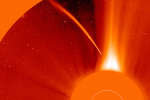 Sungrazer
21.03.2009
The Sun destroyed this comet. Arcing toward a fiery fate, this Sungrazer comet was recorded by the SOHO spacecraft's Large Angle Spectrometric COronagraph(LASCO) on 1996 Dec. 23. LASCO uses an occulting disk...
 A Rare Hybrid Solar Eclipse
3.11.2013
A spectacular geocentric celestial event of 2005 was a rare hybrid eclipse of the Sun - a total or an annular eclipse could be seen depending on the observer's location. For Fred Espenak, aboard...
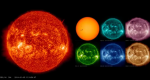 The Sun Rotating
12.03.2014
Does the Sun change as it rotates? Yes, and the changes can vary from subtle to dramatic. In the above time-lapse sequences, our Sun -- as imaged by NASA's Solar Dynamics Observatory -- is shown rotating though the entire month of January.
 APOD: 2020 August 19 Б The Sun Rotating
18.08.2020
Does the Sun change as it rotates? Yes, and the changes can vary from subtle to dramatic. In the featured time-lapse sequences, our Sun -- as imaged by NASA's Solar Dynamics Observatory -- is shown rotating though an entire month in 2014.
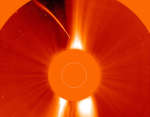 Sungrazer
27.10.2013
Arcing toward a fiery fate, this Sungrazer comet was recorded by the SOHO spacecraft's Large Angle Spectrometric COronagraph(LASCO) on December 23, 1996. LASCO uses an occulting disk, partially visible at the lower...
|
January February March April May June July August September |
|||||||||||||||||||||||||||||||||||||||||||||||||