
|
You entered: blue moon
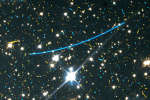 Asteroids in the Distance
6.03.2011
Rocks from space hit Earth every day. The larger the rock, though, the less often Earth is struck. Many kilograms of space dust pitter to Earth daily. Larger bits appear initially as a bright meteor. Baseball-sized rocks and ice-balls streak through our atmosphere daily, most evaporating quickly to nothing.
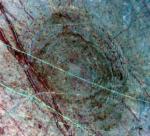 Impact on Europa
15.08.1997
This bull's-eye pattern marks the impact of a mountain-sized comet or asteroid on the icy surface of Jupiter's moon Europa. Recorded by the Galileo spacecraft in April of this year, the composite false color image clearly reveals the telltale concentric fractures which cover about
 APOD: 2024 February 14 Б Rosette Deep Field
14.02.2024
Can you find the Rosette Nebula? The large, red, and flowery-looking nebula on the upper left may seem the obvious choice, but that is actually just diffuse hydrogen emission surrounding the Cone and Fox Fur Nebulas.
 APOD: 2025 June 17 Б Rosette Nebula Deep Field
17.06.2025
Can you find the Rosette Nebula? The red flowery-looking nebula just above the image center may seem a good choice, but that's not it. The famous Rosette Nebula is really located on the lower right, here colored blue and white, and connected to the other nebulas by gold-colored filaments.
 APOD: 2024 February 27 Б Supernova Remnant Simeis 147
27.02.2024
It's easy to get lost following the intricate, looping, and twisting filaments of supernova remnant Simeis 147. Also cataloged as Sharpless 2-240, the filamentary nebula goes by the popular nickname the Spaghetti Nebula.
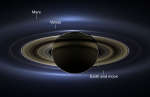 In the Shadow of Saturn
13.11.2013
In the shadow of Saturn, unexpected wonders appear. The robotic Cassini spacecraft now orbiting Saturn drifted in giant planet's shadow earlier this year and looked back toward the eclipsed Sun. Cassini saw a unique and celebrated view.
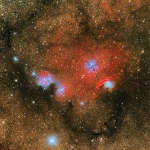 NGC 6559: East of the Lagoon
7.10.2021
Slide your telescope just east of the Lagoon Nebula to find this alluring field of view in the rich starfields of the constellation Sagittarius toward the central Milky Way. Of course the Lagoon nebula is also known as M8, the eighth object listed in Charles Messier's famous catalog of bright nebulae and star clusters.
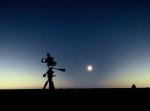 Shadow Cone of a Total Solar Eclipse
6.01.2003
Sometimes, during a total eclipse of the Sun, a strange shadow of darkness can be seen stretching off into the distance. Called a shadow cone, they are visible because the Earth's atmosphere is not completely transparent, scattering sunlight and hence appearing blue during the day.
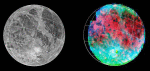 Fields of Minerals on Ganymede
7.11.1996
What treasures lie on the surface of Ganymede? Last week, NASA released a map of Jupiter's largest moon made by the Galileo Orbiter highlighting ice and minerals deposits. The leftmost photograph by Voyager...
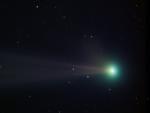 Colors of Comet Pojmanski
11.03.2006
Comet Pojmanski flew by planet Earth last weekend on a surprise trip through the inner solar system. Then an easy binocular target for morning skygazers, Pojmanski ultimately showed off a long tail, but it also presented some lovely green-blue hues as gas molecules in its tenuous coma and tail fluoresced in the sunlight.
|
January February March April May June July August |
||||||||||||||||||||||||||||||||||||||||||||||||||||||||