
|
You entered: all sky
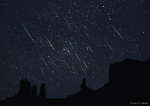 Leonids Over Monument Valley
15.11.2015
There was a shower over Monument Valley -- but not water. Meteors. The featured image -- actually a composite of six exposures of about 30 seconds each -- was taken in 2001, a year when there was a very active Leonids shower.
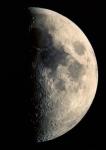 The Moon and All the Crashes
28.04.2001
A clear blue summer sky finally grows dark and the new telescope, hastily set up in the backyard, generates excitment and anticipation. "I bought it for the kids.", Dad assures himself as he anxiously supervises two young boys' efforts to center a bright, first quarter Moon in the finder.
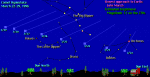 Where to See Comet Hyakutake
22.03.1996
People the world over are preparing to witness the closest approach of the brightest comet of the past twenty years. Comet Hyakutake, discovered just two months ago, will pass nearest the Earth Monday morning. All during the coming week, Comet Hyakutake will be visible in the northern sky as an unusual extended fuzzy patch.
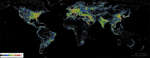 APOD: 2023 March 8 Б Artificial Night Sky Brightness
8.03.2023
Where have all the dim stars gone? From many places on the Earth including major cities, the night sky has been reduced from a fascinating display of thousands of stars to a diffuse glow through which only a few stars are visible.
 Gamma Ray Quasar
26.12.1998
The bright object in the center of the false color image above is quasar 3C279 viewed in gamma-rays, photons with more than 40 million times the energy of visible light. Like all quasars, 3C279 is a nondescript, faint, star-like object in the visible sky.
 The Cosmic Infrared Background
6.02.2002
What cosmic wallpaper is on the sky? The answer depends on the type of light considered, and for some wavelengths, all the cluttering material in the foreground makes it still unknown. Recently, however...
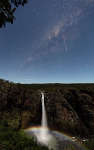 Meteor and Moonbow over Wallaman Falls
12.11.2012
Which feature takes your breath away first in this encompassing panorama of land and sky? The competition is strong with a waterfall, meteor, starfield, and even a moonbow all vying for attention. It is interesting to first note, though, what can't be seen -- a rising moon on the other side of the camera.
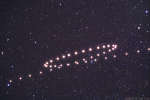 Retrograde Mars
13.06.2010
Why would Mars appear to move backwards? Most of the time, the apparent motion of Mars in Earth's sky is in one direction, slow but steady in front of the far distant stars. About every two years, however, the Earth passes Mars as they orbit around the Sun.
 Retrograde Mars
11.05.2008
Why would Mars appear to move backwards? Most of the time, the apparent motion of Mars in Earth's sky is in one direction, slow but steady in front of the far distant stars. About every two years, however, the Earth passes Mars as they orbit around the Sun.
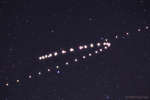 Retrograde Mars
27.10.2014
Why would Mars appear to move backwards? Most of the time, the apparent motion of Mars in Earth's sky is in one direction, slow but steady in front of the far distant stars. About every two years, however, the Earth passes Mars as they orbit around the Sun.
|
January February March April May June July August September |
|||||||||||||||||||||||||||||||||||||||||||||||||