
|
You entered: active region
 M83: The Southern Pinwheel
16.01.2025
Beautiful and bright spiral galaxy M83 lies a some twelve million light-years away, near the southeastern tip of the very long constellation Hydra. Prominent spiral arms traced by dark dust lanes and blue star clusters lend this galaxy its popular name, The Southern Pinwheel.
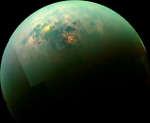 Titan Seas Reflect Sunlight
1.02.2015
Why would the surface of Titan light up with a blinding flash? The reason: a sunglint from liquid seas. Saturn's moon Titan has numerous smooth lakes of methane that, when the angle is right, reflect sunlight as if they were mirrors.
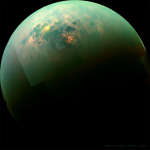 Titan Seas Reflect Sunlight
27.03.2022
Why would the surface of Titan light up with a blinding flash? The reason: a sunglint from liquid seas. Saturn's moon Titan has numerous smooth lakes of methane that, when the angle is right, reflect sunlight as if they were mirrors.
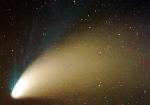 Hale-Bopp's Fickle Ion Tail
14.05.1997
What's happening to Comet Hale-Bopp's blue ion tail? The comet's ion tail is fluctuating more rapidly as it passes a region of changing solar wind. As the comet passes from north to south, it crosses the plane of the Sun's equator, where the solar magnetic field changes direction.
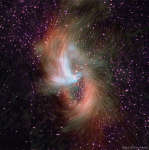 Our Galaxys Magnetic Center
19.06.2019
What's the magnetic field like in the center of our Milky Way Galaxy? To help find out, NASA's SOFIA -- an observatory flying in a modified 747 -- imaged the central region with...
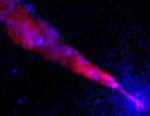 The Energetic Jet from Centaurus A
1.05.2003
The center of well-studied active galaxy Centaurus A is hidden from the view of optical telescopes by a cosmic jumble of stars, gas, and dust. But both radio and x-ray telescopes can trace the remarkable jet of high-energy particles streaming from the galaxy's core.
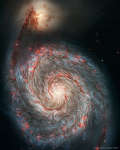 The Magnetic Field of the Whirlpool Galaxy
20.01.2021
Do magnetic fields always flow along spiral arms? Our face-on view of the Whirlpool Galaxy (M51) allows a spectacularly clear view of the spiral wave pattern in a disk-shaped galaxy. When observed with a radio telescope, the magnetic field appears to trace the arms' curvature.
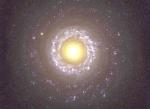 Spiral Galaxy NGC 7742
1.07.2001
This might resemble a fried egg you've had for breakfast, but it's actually much larger. In fact, ringed by blue-tinted star forming regions and faintly visible spiral arms, the yolk-yellow center of this face-on spiral galaxy, NGC 7742, is about 3,000 light-years across.
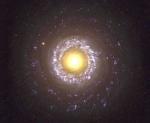 Spiral Galaxy NGC 7742
26.07.2003
This might resemble a fried egg you've had for breakfast, but it's actually much larger. In fact, ringed by blue-tinted star forming regions and faintly visible spiral arms, the yolk-yellow center of this face-on spiral galaxy, NGC 7742, is about 3,000 light-years across.
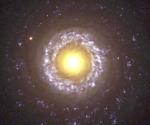 Seyfert Galaxy NGC 7742
23.10.1998
This might resemble a fried egg you've had for breakfast, but it's actually much larger. In fact, ringed by blue-tinted star forming regions and faintly visible spiral arms, the yolk-yellow center of this face-on spiral galaxy, NGC 7742, is about 3,000 light-years across.
|
January February March April May June July August September |
|||||||||||||||||||||||||||||||||||||||||||||||||