
|
You entered: gas
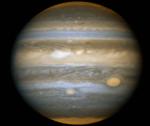 Jupiter and the Red Spots
5.05.2006
Jupiter's Great Red Spot is a swirling storm seen for over 300 years, since the beginning of telescopic observations. But in February 2006, planetary imager Christopher Go noticed it had been joined by Red Spot Jr - formed as smaller whitish oval-shaped storms merged and then developed the remarkable reddish hue.
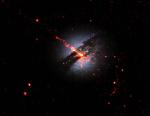 X Ray Jet From Centaurus A
28.10.1999
Spanning over 25,000 light-years, comparable to the distance from the Sun to the center of our own Milky Way galaxy, a cosmic jet seen in X-rays blasts from the center of Centaurus A. Only 10 million light-years away, Centaurus A is a giant elliptical galaxy - the closest active galaxy to Earth.
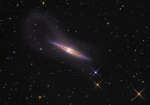 NGC 4013 and the Tidal Stream
7.02.2008
Nearly 50 million light-years away in the constellation Ursa Major, NGC 4013 was long considered an isolated island universe. Seen edge-on, the gorgeous spiral galaxy was known for its flattened disk and central bulge of stars, cut by silhouetted dust lanes.
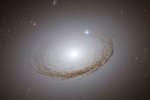 Unusual Dusty Galaxy NGC 7049
8.04.2009
How was this unusual looking galaxy created? No one is sure, especially since spiral galaxy NGC 7049 looks so strange. NGC 7049's strikingly appearance is primarily due to an unusually prominent dust ring seen mostly in silhouette. The opaque ring is much darker than the din of millions of bright stars glowing behind it.
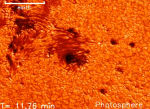 Orange Sun Oozing
6.11.2011
The Sun's surface keeps changing. The above movie shows how the Sun's surface oozes during a single hour. The Sun's photosphere has thousands of bumps called granules and usually a few dark depressions called sunspots.
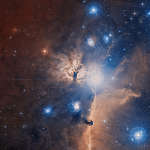 Inside the Flame Nebula
10.05.2014
The Flame Nebula stands out in this optical image of the dusty, crowded star forming regions toward Orion's belt, a mere 1,400 light-years away. X-ray data from the Chandra Observatory and infrared images from the Spitzer Space Telescope can take you inside the glowing gas and obscuring dust clouds though.
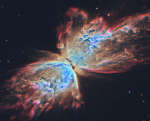 The Butterfly Nebula from Hubble
1.10.2014
The bright clusters and nebulae of planet Earth's night sky are often named for flowers or insects. Though its wingspan covers over 3 light-years, NGC 6302 is no exception. With an estimated surface...
 Simeis 147: Supernova Remnant
21.11.2019
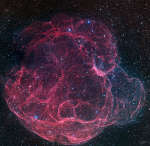
It's easy to get lost following the intricate looping filaments in this detailed image of supernova remnant Simeis 147. Also cataloged as Sharpless 2-240 it goes by the popular nickname, the Spaghetti Nebula.
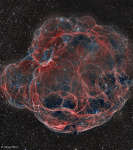 Simeis 147: Supernova Remnant
10.12.2020
It's easy to get lost following the intricate looping filaments in this detailed image of supernova remnant Simeis 147. Also cataloged as Sharpless 2-240 it goes by the popular nickname, the Spaghetti Nebula.
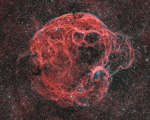 Supernova Remnant Simeis 147
13.01.2022
It's easy to get lost following the intricate, looping, twisting filaments in this detailed image of supernova remnant Simeis 147. Also cataloged as Sharpless 2-240 it goes by the popular nickname, the Spaghetti Nebula.
|
January February |
|||||||||||||||||||||||||||||||||||||||||||||||||