
|
You entered: clouds
 Mapping Mars
19.03.1999
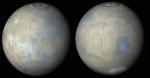
This month, the Mars Global Surveyor (MGS) spacecraft began its primary mission to the red planet. Orbiting about once every two hours at an altitude of over 200 miles, instruments onboard MGS now regularly explore the Martian surface and atmosphere.
 NGC 1499: The California Nebula
24.09.2006
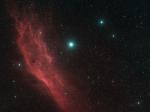
What's California doing in space? Drifting through the Orion Arm of the spiral Milky Way Galaxy, this cosmic cloud by chance echoes the outline of California on the west coast of the United States.
 The Horsehead Nebula
27.05.2007
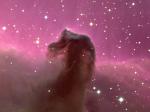
One of the most identifiable nebulae in the sky, the Horsehead Nebula in Orion, is part of a large, dark, molecular cloud. Also known as Barnard 33, the unusual shape was first discovered on a photographic plate in the late 1800s.
 Zodiacal Light Vs Milky Way
12.02.2009
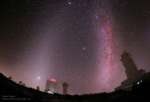
Two fundamental planes of planet Earth's sky compete for attention in this remarkable wide-angle vista, recorded on January 23rd. Arcing above the horizon and into the night at the left is a beautiful band of Zodiacal Light - sunlight scattered by dust in the solar system's ecliptic plane.
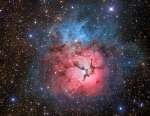 The Beautiful Trifid
25.07.2013
The beautiful Trifid Nebula is a cosmic study in contrasts. Also known as M20, it lies about 5,000 light-years away toward the nebula rich constellation Sagittarius. A star forming region in the plane...
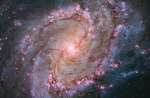 Spiral Galaxy M83: The Southern Pinwheel
28.01.2014
M83 is one of the closest and brightest spiral galaxies on the sky. Visible with binoculars in the constellation of Hydra, majestic spiral arms have prompted its nickname as the Southern Pinwheel. Although discovered...
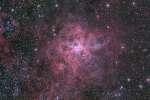 The Cosmic Web of the Tarantula Nebula
17.02.2014
It is the largest and most complex star forming region in the entire galactic neighborhood. Located in the Large Magellanic Cloud, a small satellite galaxy orbiting our Milky Way galaxy, the region's spidery appearance is responsible for its popular name, the Tarantula nebula. This tarantula, however, is about 1,000 light-years across.
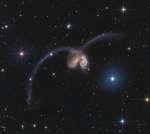 Exploring the Antennae
28.04.2017
Some 60 million light-years away in the southerly constellation Corvus, two large galaxies are colliding. Stars in the two galaxies, cataloged as NGC 4038 and NGC 4039, very rarely collide in the course of the ponderous cataclysm that lasts for hundreds of millions of years.
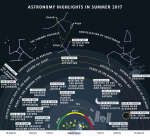 Highlights of the Summer Sky
5.06.2017
What's up in the sky this summer? The featured graphic gives a few highlights for Earth's northern hemisphere. Viewed as a clock face centered at the bottom, early summer sky events fan out toward the left, while late summer events are projected toward the right.
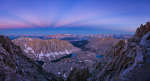 Planet Earth at Blue Hour
11.10.2019
Nature photographers and other fans of planet Earth always look forward to the blue hour. That's the transition in twilight, just before sunrise or after sunset, when the Sun is below the horizon but land and sky are still suffused with beautiful bluish hues of light.
|
January February March April May June July August September |
|||||||||||||||||||||||||||||||||||||||||||||||||