
|
You entered: Moon
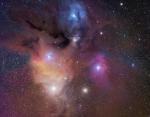 The Colorful Clouds of Rho Ophiuchi
14.07.2006
This stunning mosiac of the sky around bright stars Antares (Alpha Scorpii) and Rho Ophiuchi reveals spectacular colors in a cosmic starscape. Near the top, Rho Ophiuchi and nearby stars are immersed in blue reflection nebulae - dust clouds that shine primarily by reflected starlight.
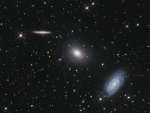 Three Galaxies in Draco
1.07.2009
This intriguing trio of galaxies is sometimes called the Draco Group, located in the northern constellation of (you guessed it) Draco. From left to right are edge-on spiral NGC 5981, elliptical galaxy NGC 5982...
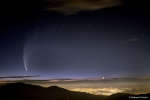 Comet McNaught Over Chile
27.01.2013
Comet McNaught of 2007 has been, so far, the most photogenic comet of our time. After making quite a show in the northern hemisphere in early 2007 January, the comet moved south and developed a long and unusual dust tail that dazzled southern hemisphere observers. In this image, Comet McNaught was captured above Santiago, Chile.
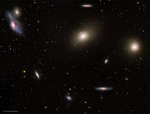 In the Heart of the Virgo Cluster
7.04.2015
The Virgo Cluster of Galaxies is the closest cluster of galaxies to our Milky Way Galaxy. The Virgo Cluster is so close that it spans more than 5 degrees on the sky - about 10 times the angle made by a full Moon.
 Asteroid 2014 JO25
20.04.2017
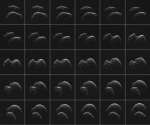
A day before its closest approach, asteroid 2014 JO25 was imaged by radar with the 70-meter antenna of NASA's Goldstone Deep Space Communications Complex in California. This grid of 30 radar images, top left to lower right, reveals the two-lobed shape of the asteroid that rotates about once every five hours.
 Milky Way and Exploding Meteor
6.08.2017
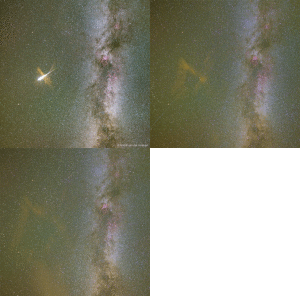
Next weekend the Perseid Meteor Shower reaches its maximum. Grains of icy rock will streak across the sky as they evaporate during entry into Earth's atmosphere. These grains were shed from Comet Swift-Tuttle.
 The Light, the Dark, and the Dusty
30.11.2022
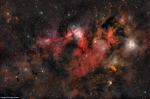
This colorful skyscape spans about four full moons across nebula rich starfields along the plane of our Milky Way Galaxy in the royal northern constellation Cepheus. Near the edge of the region's massive...
 APOD: 2023 January 17 Б Unexpected Clouds Toward the Andromeda Galaxy
17.01.2023
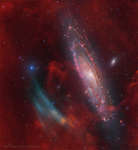
Why are there oxygen-emitting arcs near the direction of the Andromeda galaxy? No one is sure. The gas arcs, shown in blue, were discovered and first confirmed by amateur astronomers just last year.
 APOD: 2025 July 8 Б The Pleiades in Red and Blue
8.07.2025
If you have looked at the sky and seen a group of stars about the size of the full Moon, that's the Pleiades (M45). Perhaps the most famous star cluster in the sky, its brightest stars can be seen even from the light-polluted cities.
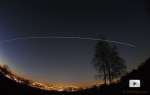 ISS: Sunlight to Shadow
28.02.2008
Orbiting 400,000 kilometers above the Earth, the Moon slid into Earth's shadow to begin last week's total lunar eclipse. Of course the International Space Station (ISS) slides into Earth's shadow every 90 minutes, the time it takes it to complete one orbit at an altitude of about 400 kilometers.
|
January February March April May June July August September October |
|||||||||||||||||||||||||||||||||||||||||||||||||