
|
You entered: rings
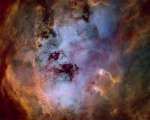 The Tadpole Nebula in Gas and Dust
19.12.2022
What's causing the commotion in the Tadpole Nebula? Star formation. Dusty emission in the Tadpole Nebula, IC 410, lies about 12,000 light-years away in the northern constellation of the Charioteer (Auriga).
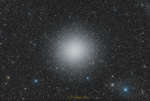 Globular Cluster Omega Centauri
11.07.2024
Globular star cluster Omega Centauri packs about 10 million stars much older than the Sun into a volume some 150 light-years in diameter. Also known as NGC 5139, at a distance...
 APOD: 2024 October 13 Б Aurora Timelapse Over Italian Alps
13.10.2024
Did you see last night's aurora? This question was relevant around much of the world a few days ago because a powerful auroral storm became visible unusually far from the Earth's poles.
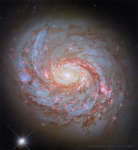 APOD: 2025 December 2 Б M77: Spiral Galaxy with an Active Center
2.12.2025
What's happening in the center of nearby spiral galaxy M77? The face-on galaxy lies a mere 47 million light-years away toward the constellation of the Sea Monster (Cetus). At that estimated distance, this gorgeous island universe is about 100 thousand light-years across.
 Neptune's Great Dark Spot: Gone But Not Forgotten
1.12.2001
When NASA's Voyager 2 spacecraft flew by distant Neptune in August of 1989, astronomers were shocked. Since Neptune receives only 3 percent the sunlight Jupiter does, they expected to find a dormant, dark, frigid planet. Instead, the Voyager images revealed evidence of a dynamic and turbulent world.
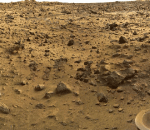 20 Years Ago: Vikings on Mars
20.07.1996
On July 20, 1976, NASA's Viking 1 lander become the first spacecraft to land on Mars, followed weeks later by its twin robot explorer, the Viking 2 lander. Operating on the Martian surface...
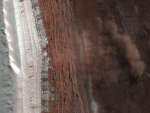 An Avalanche on Mars
11.03.2008
What caused this sudden cloud of dust on Mars? An avalanche! The first avalanche imaged in progress on another planet was recorded last month on Mars by NASA's robotic Mars Reconnaissance Orbiter. Visible...
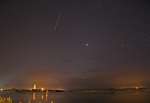 Shuttle and Meteor
14.08.2009
This early morning skyscape was captured last week on August 4th, looking northeast across calm waters in the Turn Basin at NASA's Kennedy Space Center. In a striking contrast in motion, the space...
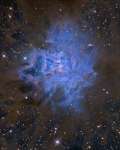 NGC 7023: The Iris Nebula
29.09.2012
Like delicate cosmic petals, these clouds of interstellar dust and gas have blossomed 1,300 light-years away in the fertile star fields of the constellation Cepheus. Sometimes called the Iris Nebula and dutifully cataloged as NGC 7023 this is not the only nebula in the sky to evoke the imagery of flowers.
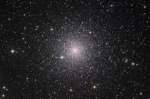 Globular Star Cluster NGC 6752
5.07.2013
Some 13,000 light-years away toward the southern constellation Pavo, the globular star cluster NGC 6752 roams the halo of our Milky Way galaxy. Over 10 billion years old, NGC 6752 follows clusters Omega Centauri and 47 Tucanae as the third brightest globular in planet Earth's night sky.
|
January February March April May |
|||||||||||||||||||||||||||||||||||||||||||||||||