
|
You entered: space
 APOD: 2025 January 12 Б Mimas: Small Moon with a Big Crater
12.01.2025
Whatever hit Mimas nearly destroyed it. What remains is one of the largest impact craters on one of Saturn's smallest round moons. Analysis indicates that a slightly larger impact would have destroyed Mimas entirely.
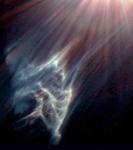 Reflecting Merope
6.12.2000
In the famous Pleiades star cluster, a star's light is slowly destroying a passing cloud of gas and dust. The star, Merope, lies just off the upper right edge of this recently released picture by the Hubble Space Telescope.
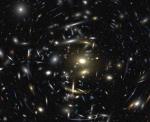 Simulated Galaxy Cluster View
6.03.2002
Stunningly detailed, this picture is a computer simulated view of a cluster of galaxies in the distant cosmos. A large, elliptical galaxy dominates this hypothetical cluster's central region surrounded by a swarm of member galaxies.
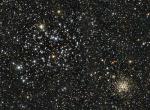 Open Star Clusters M35 and NGC 2158
29.11.2002
Open clusters of stars can be near or far, young or old, and diffuse or compact. Open clusters may contain from 100 to 10,000 stars, all of which formed at nearly the same time. Bright blue stars frequently distinguish younger open clusters.
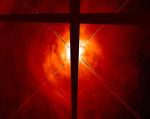 AB Aurigae: How To Make Planets
8.02.2003
This enhanced Hubble Space Telescope image shows in remarkable detail the inner portion of the disk of dust and gas surrounding the star AB Aurigae. Knots of material, visible here for the first time...
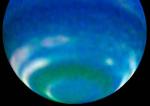 Neptune: Still Springtime After All These Years
13.06.2003
In the 1960s spring came to the southern hemisphere of Neptune, the Solar System's outermost gas giant planet. Of course, since Neptune orbits the Sun once every 165 earth-years, it's still spring for southern Neptune, where each season lasts over four decades.
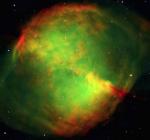 M27: Not A Comet
23.10.1999
While searching the skies above 18th century France for comets, astronomer Charles Messier diligently recorded this object as number 27 on his list of things which are definitely not comets. So what is it?
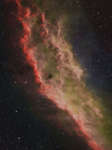 NGC 1499: The California Nebula
2.03.2011
What's California doing in space? Drifting through the Orion Arm of the spiral Milky Way Galaxy, this cosmic cloud by chance echoes the outline of California on the west coast of the United States.
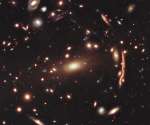 MACS 1206: A Galaxy Cluster Gravitational Len
17.10.2011
It is difficult to hide a galaxy behind a cluster of galaxies. The closer cluster's gravity will act like a huge lens, pulling images of the distant galaxy around the sides and greatly distorting them.
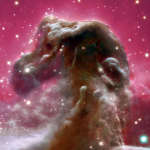 The Horsehead Nebula from Blue to Infrared
28.07.2014
One of the most identifiable nebulae in the sky, the Horsehead Nebula in Orion, is part of a large, dark, molecular cloud. Also known as Barnard 33, the unusual shape was first discovered on a photographic plate in the late 1800s.
|
January February March April May June July August September |
|||||||||||||||||||||||||||||||||||||||||||||||||