
|
You entered: star cluster
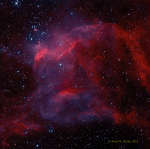 NGC 3572 and the Southern Tadpoles
8.11.2019
This cosmic skyscape features glowing gas and dark dust clouds along side the young stars of NGC 3572. A beautiful emission nebula and star cluster in far southern skies, the region is often overlooked by astroimagers in favor of its brighter neighbor, the nearby Carina Nebula.
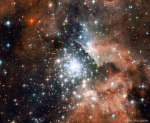 Starburst Cluster in NGC 3603
6.11.2016
A mere 20,000 light-years from the Sun lies NGC 3603, a resident of the nearby Carina spiral arm of our Milky Way Galaxy. NGC 3603 is well known to astronomers as one of the Milky Way's largest star-forming regions.
 Millions of Stars in Omega Centauri
28.03.2024
Globular star cluster Omega Centauri, also known as NGC 5139, is 15,000 light-years away. The cluster is packed with about 10 million stars much older than the Sun within a volume about 150 light-years in diameter.
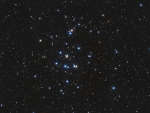 M44: The Beehive Cluster
22.02.2014
A mere 600 light-years away, M44 is one of the closest star clusters to our solar system. Also known as the Praesepe or the Beehive cluster its stars are young though, about 600 million years old compared to our Sun's 4.5 billion years.
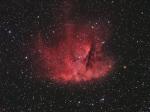 NGC 281: The Pacman Nebula
23.08.2005
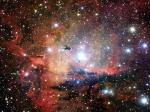
NGC 281 is a busy workshop of star formation. Prominent features include a small open cluster of stars, a diffuse red-glowing emission nebula, large lanes of obscuring gas and dust, and dense knots of dust and gas in which stars may still be forming.
 NGC 281: Cluster, Clouds, and Globules
7.04.2003
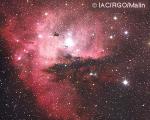
NGC 281 is a busy workshop of star formation. Prominent features include a small open cluster of stars, a diffuse red-glowing emission nebula, large lanes of obscuring gas and dust, and dense knots of dust and gas in which stars may still be forming.
 NGC 281: Cluster, Clouds, and Globules
21.09.1998
NGC 281 is a busy workshop of star formation. Prominent features include a small open cluster of stars, a diffuse red-glowing emission nebula, large lanes of obscuring gas and dust, and dense knots of dust and gas in which stars may still be forming.
 Giant Emission Nebula NGC 3603 in Infrared
14.08.2002
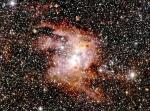
NGC 3603 is the largest region of glowing gas in our Milky Way galaxy. Spanning over 20 light years across, the giant emission nebula (HII region) is home to a massive star cluster, thick dust pillars, and a star about to explode.
 Comet Lovejoy in a Winter Sky
27.01.2015
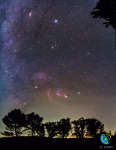
Which of these night sky icons can you find in this beautiful and deep exposure of the northern winter sky? Skylights include the stars in Orion's belt, the Orion Nebula, the Pleiades star cluster, the bright stars Betelgeuse and Rigel, the California Nebula, Barnard's Loop, and Comet Lovejoy.
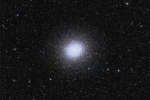 Omega Centauri: The Largest Globular Cluster Known
1.03.2009
This huge ball of stars predates our Sun. Long before humankind evolved, before dinosaurs roamed, and even before our Earth existed, ancient globs of stars condensed and orbited a young Milky Way Galaxy. Of the 200 or so globular clusters that survive today, Omega Centauri is the largest, containing over ten million stars.
|
January February March April May June July August September |
|||||||||||||||||||||||||||||||||||||||||||||||||