
|
You entered: blue moon
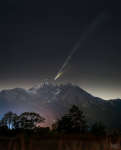 APOD: 2025 November 4 Б Comet Lemmon Beyond Lomnickц Peak
4.11.2025
Comet Lemmon has been putting on a show for cameras around the globe. Passing nearest to Earth in late October, the photogenic comet C/2025 A6 (Lemmon) sprouted two long and picturesque tails: a blue ion tail and a white dust tail.
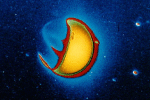 Ultraviolet Earth
10.06.1996
Here's a switch: the above picture is of the Earth taken from a lunar observatory! This false color picture shows how the Earth glows in ultraviolet (UV) light. UV light is so blue humans can't see it.
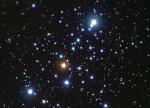 Distant Open Cluster M103
7.02.2001
Bright blue stars highlight the open cluster known as M103. The gas clouds from which these stars condensed has long dispersed. Of the stars that were formed, the brightest, bluest, and most massive have already used up their nuclear fuel and self-destructed in supernova explosions.
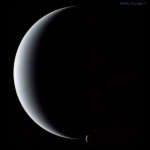 Crescent Neptune and Triton
25.07.2021
Gliding silently through the outer Solar System, the Voyager 2 spacecraft camera captured Neptune and Triton together in crescent phase. The elegant picture of the gas giant planet and its cloudy moon was taken from behind just after closest approach in 1989.
 Shadow Set
4.02.2006
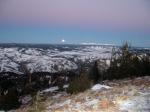
A nearly full Moon and planet Earth's shadow set together in this scene captured on January 13th from snowy Mt. Jelm, home of the Wyoming Infrared Observatory. For early morning risers (and late...
 NGC 6188 and NGC 6164
1.02.2014
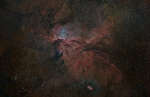
Fantastic shapes lurk in clouds of glowing gas in NGC 6188, about 4,000 light-years away. The emission nebula is found near the edge of a large molecular cloud unseen at visible wavelengths, in the southern constellation Ara.
 Asteroids in the Distance
23.06.2002
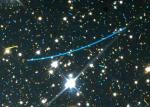
Rocks from space hit Earth every day. The larger the rock, though, the less often Earth is struck. Many kilograms of space dust pitter to Earth daily. Larger bits appear initially as a bright meteor. Baseball-sized rocks and ice-balls streak through our atmosphere daily, most evaporating quickly to nothing.
 Shadow Set
27.01.2005
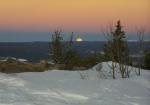
A nearly full Moon and planet Earth's shadow set together in this scene captured Monday from snowy Mt. Jelm, home of the Wyoming Infrared Observatory. For early morning risers (and late...
 Dark River Wide Field
19.07.2010
A Dark River of dust seems to run from our Galactic Center, then pool into a starfield containing photogenic sky wonders. Scrolling right will reveal many of these objects including (can you find?)...
 Asteroids in the Distance
17.04.2005
Rocks from space hit Earth every day. The larger the rock, though, the less often Earth is struck. Many kilograms of space dust pitter to Earth daily. Larger bits appear initially as a bright meteor. Baseball-sized rocks and ice-balls streak through our atmosphere daily, most evaporating quickly to nothing.
|
January February March April May June July August |
||||||||||||||||||||||||||||||||||||||||||||||||||||||||