
|
You entered: color
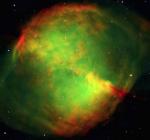 M27: Not A Comet
23.10.1999
While searching the skies above 18th century France for comets, astronomer Charles Messier diligently recorded this object as number 27 on his list of things which are definitely not comets. So what is it?
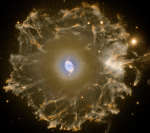 Halo of the Cats Eye
9.05.2010
The Cat's Eye Nebula (NGC 6543) is one of the best known planetary nebulae in the sky. Its haunting symmetries are seen in the very central region of this stunning false-color picture, processed...
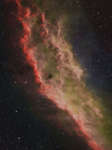 NGC 1499: The California Nebula
2.03.2011
What's California doing in space? Drifting through the Orion Arm of the spiral Milky Way Galaxy, this cosmic cloud by chance echoes the outline of California on the west coast of the United States.
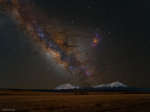 Milky Way Over the Spanish Peaks
24.05.2016
That's not lightning, and it did not strike between those mountains. The diagonal band is actually the central band of our Milky Way Galaxy, while the twin peaks are actually called the Spanish Peaks -- but located in Colorado, USA.
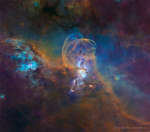 Star Forming Region NGC 3582 without Stars
20.09.2022
What's happening in the Statue of Liberty nebula? Bright stars and interesting molecules are forming and being liberated. The complex nebula resides in the star forming region called RCW 57, and besides the iconic monument, to some looks like a flying superhero or a weeping angel.
 APOD: 2023 April 9 Б The Egg Nebula in Polarized Light
9.04.2023
Where is the center of the Egg Nebula? Emerging from a cosmic egg, the star in the center of the Egg Nebula is casting away shells of gas and dust as it slowly transforms itself into a white dwarf star. The Egg Nebula is a rapidly evolving pre- planetary nebula spanning about one light year.
 APOD: 2023 July 9 Б Doomed Star Eta Carinae
9.07.2023
Eta Carinae may be about to explode. But no one knows when - it may be next year, it may be one million years from now. Eta Carinae's mass - about 100 times greater than our Sun - makes it an excellent candidate for a full blown supernova.
 APOD: 2023 November 7 Б A Martian Dust Devil Spins By
7.11.2023
It moved across the surface of Mars -- what was it? A dust devil. Such spinning columns of rising air are heated by the warm surface and are also common in warm and dry areas on planet Earth.
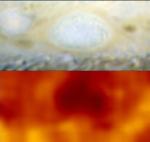 Jupiter: When Storms Collide
22.10.1998
Sometime in February, two of three long-lived Jovian storm systems known as "white ovals" apparently collided and merged -- forming what is now likely the second largest storm in the Solar System, after the famous Great Red Spot.
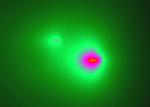 Another Comet LINEAR Breaks Up
21.05.2001
Last year, a different comet LINEAR (C/1999 S4) broke up. This year, a comet first imaged by the Lincoln Near Asteroid Research (LINEAR) telescope in New Mexico on 2001 January 3, is also breaking up.
|
January February |
|||||||||||||||||||||||||||||||||||||||||||||||||