
|
You entered: galaxies
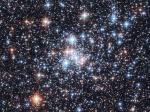 Open Cluster NGC 290: A Stellar Jewel Box
1.05.2006
Jewels don't shine this bright -- only stars do. Like gems in a jewel box, though, the stars of open cluster NGC 290 glitter in a beautiful display of brightness and color. The photogenic cluster, pictured above, was captured recently by the orbiting Hubble Space Telescope.
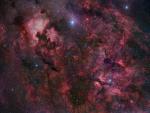 Northern Cygnus
20.09.2007
Bright, hot, supergiant star Deneb lies at top center in this gorgeous skyscape. The 20 frame mosaic spans an impressive 12 degrees across the northern end of Cygnus the Swan. Crowded with stars...
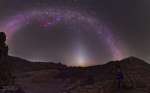 Zodiacal Light Vs. Milky Way
20.03.2010
Ghostly Zodiacal light, featured near the center of this remarkable panorama, is produced as sunlight is scattered by dust in the Solar System's ecliptic plane. In the weeks surrounding the March equinox (today...
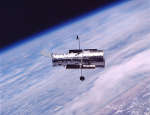 Two New Hubble Quality Telescopes Gifted to NASA
10.06.2012
What if you were given a new Hubble telescope for free? How about two? The astronomical community is abuzz with just this opportunity as the US National Reconnaissance Office has unexpectedly transferred ownership of two space-qualified Hubble-quality telescopes to NASA.
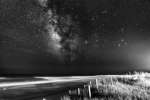 Shoreline of the Universe
20.09.2014
Against dark rifts of interstellar dust, the ebb and flow of starlight along the Milky Way looks like waves breaking on a cosmic shore in this night skyscape. Taken with a digital camera from...
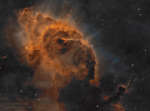 HH 666: Carina Dust Pillar with Jet
6.12.2017
To some, it may look like a beehive harboring an evil bee. In reality, the featured Hubble image captures a cosmic pillar of dust, two-light years long, inside of which is Herbig-Haro 666 -- a young star emitting powerful jets.
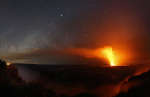 Jupiter Season, Hawaiian Sky
2.06.2018
Volcanic activity on the Big Island of Hawaii has increased since this Hawaiian night skyscape was recorded earlier this year. Recent vents and lava flows are about 30 kilometers to the east, the direction...
 NGC6366 vs 47 Ophiuchi
23.05.2025
Most globular star clusters roam the halo of our Milky Way galaxy, but globular cluster NGC 6366 lies close to the galactic plane. About 12,000 light-years away toward the constellation Ophiuchus, the cluster's starlight is dimmed and reddened by the Milky Way's interstellar dust when viewed from planet Earth.
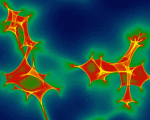 A Network of Microlensing Caustics
15.12.2002
A virtual sky map like this would be of interest to astronomers studying gravitational microlensing. In microlensing, the gravity of stars near the line of sight can act to magnify the light of background objects such as distant stars, or quasars. Nowhere is this magnification greater than near a gravitational lensing caustic.
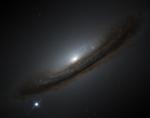 Supernova 1994D and the Unexpected Universe
30.12.1998
Far away, long ago, a star exploded. Supernova 1994D, visible as the bright spot on the lower left, occurred in the outskirts of disk galaxy NGC 4526. Supernova 1994D was not of interest for how different it was, but rather for how similar it was to other supernovae.
|
January February March April May |
|||||||||||||||||||||||||||||||||||||||||||||||||