
|
You entered: dust
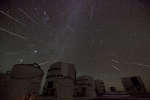 When Gemini Sends Stars to Paranal
13.12.2015
From a radiant point in the constellation of the Twins, the annual Geminid meteor shower rain down on planet Earth. Tonight, the Geminds reach their peak and could be quite spectacular. The featured blended image, however, captured the shower's impressive peak in the year 2012.
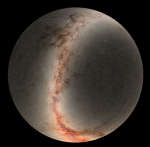 Pan STARRS Across the Sky
5.04.2019
This astronomical sky spanning view is a mosaic from the Pan-STARRS observatory. The images were recorded with its 1.8 meter telescope at the summit of Haleakala on planet Earth's island of Maui. In fact, Earth's north celestial pole is centered in this across-the-sky projection.
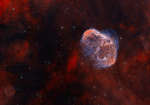 Cygnus: Bubble and Crescent
17.10.2020
These clouds of gas and dust drift through rich star fields along the plane of our Milky Way Galaxy toward the high flying constellation Cygnus. Caught within the telescopic field of view are the Soap Bubble (lower left) and the Crescent Nebula (upper right).
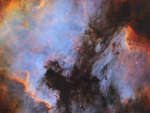 North America and the Pelican
16.09.2021
Fans of our fair planet might recognize the outlines of these cosmic clouds. On the left, bright emission outlined by dark, obscuring dust lanes seems to trace a continental shape, lending the popular name North America Nebula to the emission region cataloged as NGC 7000.
 Pillars of Creation
20.10.2022
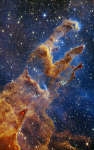
A now famous picture from the Hubble Space Telescope featured these star forming columns of cold gas and dust light-years long inside M16, the Eagle Nebula, dubbed the Pillars of Creation. This James Webb Space Telescope NIRCam image expands Hubble's exploration of that region in greater detail and depth inside the iconic stellar nursery.
 A Spiral Galaxy Gallery
9.04.1996
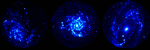
A progression of beautiful spiral galaxies is illustrated above with three photographs from NASA's Ultraviolet Imaging Telescope (UIT). Flying above the Earth's obscuring layer of atmosphere on the Space Shuttle Columbia during...
 A Quasar Portrait Gallery
25.11.1996
QUASARs (QUASi-stellAR objects) lie near the edge of the observable Universe. Discovered in 1963, astronomers were astounded - to be visible at such extreme distances of billions of light-years they must emit prodigious amounts of energy. Where does the energy come from?
 Martian Analemma
26.06.2003
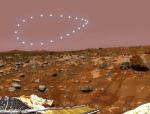
On planet Earth, an analemma is the figure-8 loop you get when you mark the position of the Sun at the same time each day throughout the year. But similarly marking the position...
 M42: Inside the Orion Nebula
20.03.2013
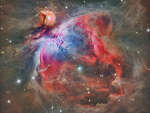
The Great Nebula in Orion, an immense, nearby starbirth region, is probably the most famous of all astronomical nebulas. Here, glowing gas surrounds hot young stars at the edge of an immense interstellar molecular cloud only 1500 light-years away.
 PanSTARRS: The Anti Tail Comet
29.06.2013
Once known as Earth's sunset comet, PanSTARRS (C/2011 L4) is up all night now, but only for northern hemisphere skygazers. Telescopes are required to track its progress as it fades and heads for the outer solar system.
|
January February March April May June July August September |
|||||||||||||||||||||||||||||||||||||||||||||||||