
|
You entered: NASA
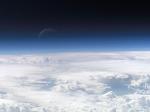 A Blue Crescent Moon from Space
20.03.2007
What's happening to the Moon? Drifting around the Earth in 2006 July, astronauts from the International Space Station (ISS) captured a crescent Moon floating far beyond the horizon. The captured above image is interesting because part of the Moon appears blue, and because part of the moon appears missing.
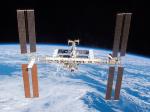 The International Space Station Expands Again
25.06.2007
The developing International Space Station (ISS) has changed its appearance again. During the past week, the Space Shuttle Atlantis visited the ISS and added pieces of the Integrated Truss Structure that mirrored those added in September 2006, including a second impressively long array of solar panels.
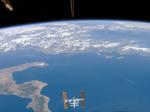 Space Station Over the Ionian Sea
27.11.2007
Last August, the Space Shuttle Endeavor crew captured this shot of the International Space Station (ISS) against the backdrop of Planet Earth. During that trip to the ISS, the space shuttle crew re-supplied the station, repaired the station, and even built more of the station.
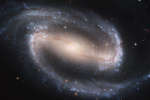 Barred Spiral Galaxy NGC 1300
22.06.2008
Big, beautiful, barred spiral galaxy NGC 1300 lies some 70 million light-years away on the banks of the constellation Eridanus. This Hubble Space Telescope composite view of the gorgeous island universe is one of the largest Hubble images ever made of a complete galaxy.
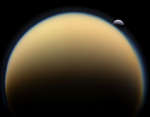 Tethys Behind Titan
27.01.2010
What's that behind Titan? It's another of Saturn's moons: Tethys. The robotic Cassini spacecraft orbiting Saturn captured the heavily cratered Tethys slipping behind Saturn's atmosphere-shrouded Titan late last year. The largest crater on Tethys, Odysseus, is easily visible on the distant moon.
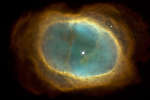 NGC 3132: The Eight Burst Nebula
26.06.2011
It's the dim star, not the bright one, near the center of NGC 3132 that created this odd but beautiful planetary nebula. Nicknamed the Eight-Burst Nebula and the Southern Ring Nebula, the glowing gas originated in the outer layers of a star like our Sun.
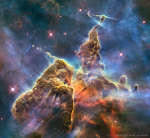 Mountains of Dust in the Carina Nebula
2.07.2017
It's stars versus dust in the Carina Nebula and the stars are winning. More precisely, the energetic light and winds from massive newly formed stars are evaporating and dispersing the dusty stellar nurseries in which they formed.
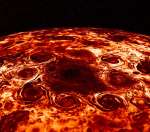 Cyclones at Jupiter s North Pole
8.03.2018
Juno's Jovian Infrared Auroral Mapper data was used to construct this stunning view of cyclones at Jupiter's North Pole. Measuring the thermal emission from Jovian cloud tops, the infrared the observations are not restricted to the hemisphere illuminated by sunlight.
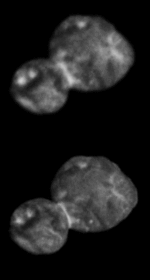 Ultima Thule Rotation Gif
4.01.2019
Ultima Thule is the most distant world explored by a spacecraft from Earth. In the dim light 6.5 billion kilometers from the Sun, the New Horizons spacecraft captured these two frames 38 minutes apart as it sped toward the Kuiper belt world on January 1 at 51,000 kilometers per hour.
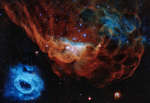 Hubble s Cosmic Reef
25.04.2020
These bright ridges of interstellar gas and dust are bathed in energetic starlight. With its sea of young stars, the massive star-forming region NGC 2014 has been dubbed the Cosmic Reef. Drifting just...
|
January February |
|||||||||||||||||||||||||||||||||||||||||||||||||