
|
You entered: white dwarf
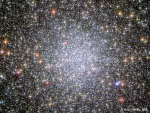 Globular Star Cluster 47 Tuc
19.05.2015
Globular star cluster 47 Tucanae is a jewel box of the southern sky. Also known as NGC 104, it roams the halo of our Milky Way Galaxy along with over 150 other globular star clusters.
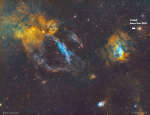 A Bright Nova in Cassiopeia
7.06.2021
WhatБs that new spot of light in Cassiopeia? A nova. Although novas occur frequently throughout the universe, this nova, known as Nova Cas 2021 or V1405 Cas, became so unusually bright in the skies of Earth last month that it was visible to the unaided eye.
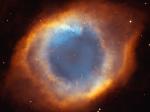 NGC 7293: The Helix Nebula
10.05.2003
Will our Sun look like this one day? The Helix Nebula is the closest example of a planetary nebula created at the end of the life of a Sun-like star. The outer gasses of the star expelled into space appear from our vantage point as if we are looking down a helix.
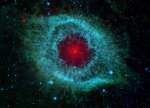 Dust and the Helix Nebula
31.12.2009
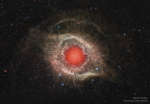
Dust makes this cosmic eye look red. The eerie Spitzer Space Telescope image shows infrared radiation from the well-studied Helix Nebula (NGC 7293) a mere 700 light-years away in the constellation Aquarius.
 The Helix Nebula in Infrared
20.09.2016
What makes this cosmic eye look so red? Dust. The featured image from the robotic Spitzer Space Telescope shows infrared light from the well-studied Helix Nebula (NGC 7293) a mere 700 light-years away in the constellation of the Water Carrier Aquarius.
 Star Wars in NGC 664
25.02.1997
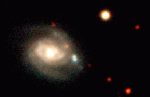
Long ago in a galaxy far, far away, locked in their final desperate struggle against the force of gravity ... two stars exploded! Stellar explosions - Supernovae - are among the most powerful events in the Universe, estimated to release an equivalent energy of up to 1 million trillion trillion (1 followed by 30 zeros) megatons of TNT.
 Star Wars in NGC 664
18.04.1998
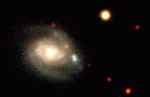
Long ago in a galaxy far, far away, locked in their final desperate struggle against the force of gravity ... two stars exploded! stellar explosions - Supernovae - are among the most powerful events in the Universe, estimated to release an equivalent energy of up to 1 million trillion trillion (1 followed by 30 zeros) megatons of TNT.
 Star Wars in NGC 664
15.05.1999
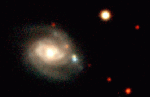
Long ago in a galaxy far, far away, locked in their final desperate struggle against the force of gravity ... two stars exploded! stellar explosions - Supernovae - are among the most powerful events in the Universe, estimated to release an equivalent energy of up to 1 million trillion trillion (1 followed by 30 zeros) megatons of TNT.
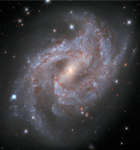 Supernova in NGC 2525
23.10.2020
Big, beautiful, barred spiral galaxy NGC 2525 lies 70 million light-years from the Milky Way. It shines in Earth's night sky within the boundaries of the southern constellation Puppis. About 60,000 light-years...
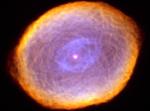 IC 418: The Spirograph Nebula
17.10.2004
What is creating the strange texture of IC 418? Dubbed the Spirograph Nebula for its resemblance to drawings from a cyclical drawing tool, planetary nebula IC 418 shows patterns that are not well understood. Perhaps they are related to chaotic winds from the variable central star, which changes brightness unpredictably in just a few hours.
|
January February March April May June July August September |
|||||||||||||||||||||||||||||||||||||||||||||||||