
|
You entered: magnetic field
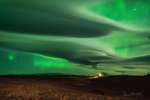 Aurora over Clouds
24.11.2015
Auroras usually occur high above the clouds. The auroral glow is created when fast-moving particles ejected from the Sun impact the Earth's magnetosphere, from which charged particles spiral along the Earth's magnetic field to strike atoms and molecules high in the Earth's atmosphere.
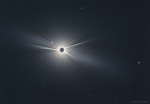 Wide Field View of Great American Eclipse
30.01.2019
Only in the fleeting darkness of a total solar eclipse is the light of the solar corona easily visible. Normally overwhelmed by the bright solar disk, the expansive corona, the sun's outer atmosphere, is an alluring sight.
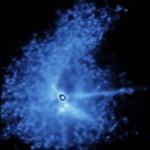 The T Tauri Star Forming System
4.06.2001
What did the Sun look like before there were planets? A prototype laboratory for the formation of low mass stars like our Sun is the T Tauri system, one of the brighter star systems toward the constellation of Taurus. In young systems, gravity causes a gas cloud to condense.
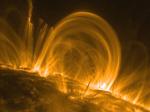 Heating Coronal Loops
14.08.2005
Why is the corona of the Sun so hot? Extending above the photosphere or visible surface of the Sun, the faint, tenuous solar corona can't be easily seen from Earth, but it is measured to be hundreds of times hotter than the photosphere itself.
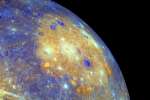 Enhanced Color Caloris
10.07.2008
The sprawling Caloris basin on Mercury is one of the solar system's largest impact basins. Created during the early history of the solar system by the impact of a large asteroid-sized body, the basin spans about 1,500 kilometers and is seen in yellowish hues in this enhanced color mosaic.
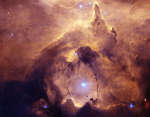 A Massive Star in NGC 6357
21.11.2010
For reasons unknown, NGC 6357 is forming some of the most massive stars ever discovered. One such massive star, near the center of NGC 6357, is framed above carving out its own interstellar castle with its energetic light from surrounding gas and dust.
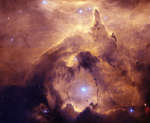 A Massive Star in NGC 6357
22.10.2013
For reasons unknown, NGC 6357 is forming some of the most massive stars ever discovered. One such massive star, near the center of NGC 6357, is framed above carving out its own interstellar castle with its energetic light from surrounding gas and dust.
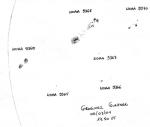 Islands in the Photosphere
15.03.2001
Awash in a sea of plasma and anchored in magnetic fields, sunspots are planet-sized, dark islands in the solar photosphere, the bright surface of the Sun. Before the enlightened(!) age of cameras, solar observers created detailed drawings of sunspots as they changed and progressed across the visible solar disk.
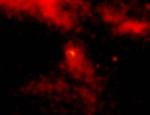 Pulsar Wind in the Vela Nebula
19.07.2001
The Vela pulsar was born 10,000 years ago at the center of a supernova -- an exploding star. In this Chandra Observatory x-ray image, the pulsar still produces a glowing nebula at the heart of the expanding cloud of stellar debris.
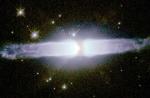 Henize 3 401: An Elongated Planetary Nebula
31.07.2002
How do dying stars eject their outer layers? Stars that create elegant planetary nebulas like Henize 3-401, pictured above, are not unusual, causing speculation that, one day, our own Sun may look like this.
|
January February March April May June July August September October |
|||||||||||||||||||||||||||||||||||||||||||||||||