
|
You entered: magellanic clouds
 3 ATs
3 ATs
4.05.2024
Despite their resemblance to R2D2, these three are not the droids you're looking for. Instead, the enclosures house 1.8 meter Auxiliary Telescopes (ATs) at Paranal Observatory in the Atacama Desert region of Chile.
 Galaxies in Space
8.03.2025
The plane of our Milky Way galaxy extends beyond the limb of planet Earth in this space age exposure captured by astronaut Don Pettit. His camera, with low light and long duration settings, was pointed out the window of a Dragon crew spacecraft docked with the International Space Station on January 29.
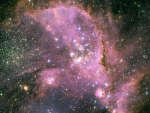 Young Stars of NGC 346
28.09.2008
The massive stars of NGC 346 are short lived, but very energetic. The star cluster is embedded in the largest star forming region in the Small Magellanic Cloud, some 210,000 light-years distant. Their...
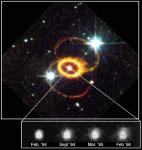 Supernova 1987a Fireball Resolved
24.01.1997
Ten years ago the most notable supernova of modern times was observed. In February 1987, light reached Earth from a star which exploded in the nearby Large Magellanic Cloud galaxy. Supernova 1987a remains the closest supernova since the invention of the telescope.
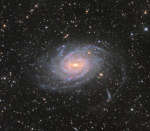 Spiral Galaxy NGC 6744
5.12.2019
Beautiful spiral galaxy NGC 6744 is nearly 175,000 light-years across, larger than our own Milky Way. It lies some 30 million light-years distant in the southern constellation Pavo and appears as only a faint, extended object in small telescopes.
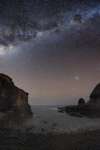 The Milky Way Over Pulpit Rock
5.07.2010
Can a picture of the sky be relaxing? A candidate for such a picture might be the above image taken only last month from Cape Schank, Victoria, Australia. The frame is highlighted by a quiet lagoon, soft ground fog, two galaxies, and tens of thousands of stars.
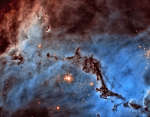 N11: Star Clouds of the LMC
11.02.2013
Massive stars, abrasive winds, mountains of dust, and energetic light sculpt one of the largest and most picturesque regions of star formation in the Local Group of Galaxies. Known as N11, the region...
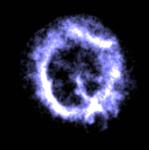 X-ray Hot Supernova Remnant in the SMC
9.12.1999
The Q-shaped cloud seen in this false-color X-ray image from the orbiting Chandra Observatory is big ... about 40 light-years across. It's hot too, as its X-ray glow is produced by multi-million degree gas.
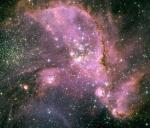 Young Stars of NGC 346
17.11.2005
Star cluster NGC 346 is embedded in the largest star forming region in the Small Magellanic Cloud, some 210,000 light-years distant. The massive stars of NGC 346 are short lived, but very energetic.
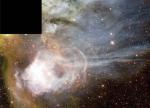 N44C: A Nebular Mystery
14.05.2002
Why is N44C glowing so strangely? The star that appears to powers the nebula, although young and bright, does not seem hot enough to create some of the colors observed. A search for a hidden hotter star in X-rays has come up empty.
|
January February March April May June July August September |
|||||||||||||||||||||||||||||||||||||||||||||||||