
|
You entered: galaxy formation
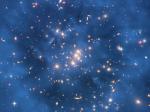 Dark Matter Ring Modeled around Galaxy Cluster CL0024 17
16.05.2007
How do we know that dark matter isn't just normal matter exhibiting strange gravity? A new observation of gravitationally magnified faint galaxies far in the distance behind a massive cluster of galaxies is shedding new dark on the subject.
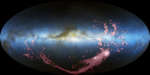 The Magellanic Stream
25.01.2010
Spanning the sky toward the majestic Clouds of Magellan is an unusual stream of gas: the Magellanic Stream. The origin of this gas remains unknown but likely hold a clue to origin and fate of our Milky Way's most famous satellite galaxies: the LMC and the SMC.
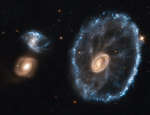 Cartwheel of Fortune
25.01.2018
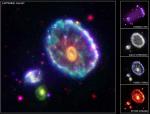
By chance, a collision of two galaxies has created a surprisingly recognizable shape on a cosmic scale, The Cartwheel Galaxy. The Cartwheel is part of a group of galaxies about 500 million light years away in the constellation Sculptor. Two smaller galaxies in the group are visible on the right.
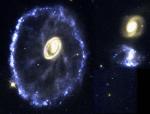 Cartwheel Of Fortune
19.12.1998
By chance, a collision of two galaxies has created a surprisingly recognizable shape on a cosmic scale - "The Cartwheel Galaxy". The Cartwheel is part of a group of galaxies about 500 million light years away in the constellation Sculptor (two smaller galaxies in the group are visible on the right).
 Cartwheel Of Fortune
18.01.2006
By chance, a collision of two galaxies has created a surprisingly recognizable shape on a cosmic scale - The Cartwheel Galaxy. The Cartwheel is part of a group of galaxies about 400 million light years away in the constellation Sculptor (two smaller galaxies in the group are visible below and left).
 Messier 63: The Sunflower Galaxy
6.06.2019
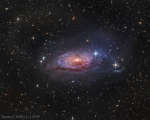
A bright spiral galaxy of the northern sky, Messier 63 is about 25 million light-years distant in the loyal constellation Canes Venatici. Also cataloged as NGC 5055, the majestic island universe is nearly 100,000 light-years across. That's about the size of our own Milky Way Galaxy.
 Messier 63: The Sunflower Galaxy
12.07.2017
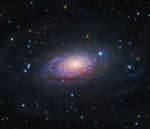
A bright spiral galaxy of the northern sky, Messier 63 is about 25 million light-years distant in the loyal constellation Canes Venatici. Also cataloged as NGC 5055, the majestic island universe is nearly 100,000 light-years across. That's about the size of our own Milky Way Galaxy.
 NGC 1569: Starburst in a Small Galaxy
5.02.2004
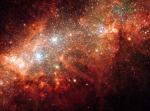
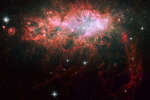
Grand spiral galaxies often seem to get all the glory, flaunting their young, bright, blue star clusters in beautiful, symmetric spiral arms. But small, irregular galaxies form stars too. In fact, as pictured here...
 NGC 1569: Starburst in a Dwarf Irregular Galaxy
29.12.2008
Grand spiral galaxies often seem to get all the glory, flaunting their young, bright, blue star clusters in beautiful, symmetric spiral arms. But small, irregular galaxies form stars too. In fact, as pictured here...
 The Supermassive Black Holes of NGC 6240
28.11.2002
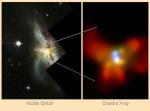
The Hubble optical image on the left shows NGC 6240 in the throes of a titanic galaxy - galaxy collision 400 million light-years away. As the cosmic catastrophe plays out, the merging galaxies spew forth distorted tidal tails of stars, gas, and dust and undergo frantic bursts of star formation.
|
January February March April May June July August |
||||||||||||||||||||||||||||||||||||||||||||||||||||||||