
|
You entered: crescent
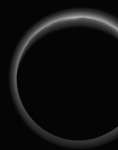 Pluto at Night
25.03.2022
The night side of Pluto spans this shadowy scene. In the stunning spacebased perspective the Sun is 4.9 billion kilometers (almost 4.5 light-hours) behind the dim and distant world. It was captured...
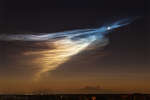 APOD: 2024 July 9 Б Noctilucent Clouds over Florida
8.07.2024
These clouds are doubly unusual. First, they are rare noctilucent clouds, meaning that they are visible at night -- but only just before sunrise or just after sunset. Second, the source of these noctilucent clouds is actually known.
 Pluto at Night
15.11.2024
The night side of Pluto spans this shadowy scene. In the stunning spacebased perspective the Sun is 4.9 billion kilometers (almost 4.5 light-hours) behind the dim and distant world. It was captured...
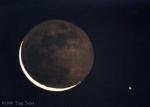 Mercury And The Moon
10.11.1999
Mercury is the closest planet to the Sun and never moves far from our parent star in Earth's sky. Racing around its tight orbit, this well-done world is a little over 1/3 the diameter of Earth and is often lost to our view in the solar glare.
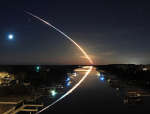 Waterway to Orbit
12.02.2010
The 32nd shuttle mission to the International Space Station, STS-130, left planet Earth on February 8. Its early morning launch to orbit from Kennedy Space Center's pad 39A followed the long, graceful, eastward arc seen in this 2 minute time exposure.
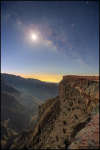 Milky Way in Moonlight
22.04.2016
A waning crescent moon, early morning twilight, and Al Hamra's city lights on the horizon can't hide the central Milky Way in this skyscape from planet Earth. Captured in a single exposure...
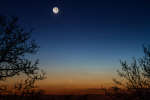 PanSTARRS from France
16.03.2013
Still looking for that comet? Comet PanSTARRS (C/2011 L4) naked-eye appearance in the northern hemisphere is described by successful comet spotters as a dim star with faint a tail. If you want to catch it the next few days could be your best bet.
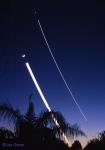 Venus Falls Out of the Evening Sky
3.09.1999
Orbiting closer to the Sun than planet Earth, bright Venus always appears to be near the Sun's position in our sky and often shines near the horizon in twilight hours. In fact, after...
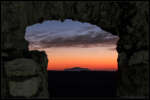 Venus and Mercury at Sunset
14.01.2015
Inner planets Venus and Mercury can never wander far from the Sun in Earth's sky. This week you've probably seen them both gathered near the western horizon just after sunset, a close conjunction of bright celestial beacons in the fading twilight.
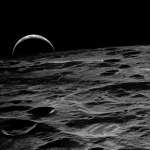 Apollo 14 Heads for Home
31.01.2020
When leaving lunar orbit in February 1971, the crew of Apollo 14 watched this Earthrise from their command module Kittyhawk. With Earth's sunlit crescent just peaking over the lunar horizon, the cratered terrain in the foreground is along the lunar farside.
|
January February March April May June July August |
||||||||||||||||||||||||||||||||||||||||||||||||||||||||