
|
You entered: blue moon
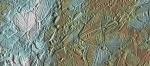 Europa's Disconnected Surface
2.01.1998
Jupiter's moon Europa is so exciting that the Galileo spacecraft orbiting Jupiter has now embarked on an extended mission to study it. Oceans that might exist beneath Europa's surface are thought to be one of the best places to look for life in our Solar System.
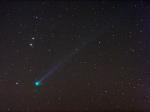 Unexpected Comet Pojmanski Now Visible
6.03.2006
Have you ever seen a comet? Comets bright enough to be visible to the unaided eye appear only every few years. Right now, however, a new comet has brightened unexpectedly and is visible as a faint streak to the unaided northern observer in the eastern morning sky just before sunrise. Binoculars may help.
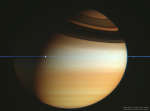 Cassini Spacecraft Crosses Saturns Ring Plane
29.12.2019
If this is Saturn, where are the rings? When Saturn's "appendages" disappeared in 1612, Galileo did not understand why. Later that century, it became understood that Saturn's unusual protrusions were rings and that when the Earth crosses the ring plane, the edge-on rings will appear to disappear.
 Crescent Neptune and Triton
13.12.2009
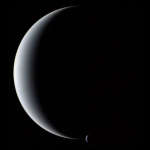
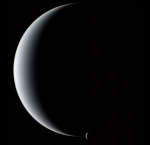
Gliding silently through the outer Solar System, the Voyager 2 spacecraft camera captured Neptune and Triton together in crescent phase in 1989. The above picture of the gas giant planet and its cloudy moon was taken from behind just after closest approach.
 Crescent Neptune and Triton
14.04.2013
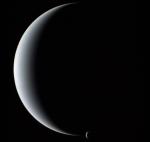
Gliding silently through the outer Solar System, the Voyager 2 spacecraft camera captured Neptune and Triton together in crescent phase in 1989. The elegant picture of the gas giant planet and its cloudy moon was taken from behind just after closest approach.
 Crescent Neptune and Triton
19.06.2001
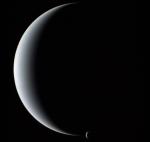
Gliding silently through the outer Solar System, the Voyager 2 spacecraft camera captured Neptune and Triton together in crescent phase in 1989. The above picture of the gas giant planet and its cloudy moon was taken from behind just after closest approach.
 Crescent Neptune and Triton
18.06.2006
Gliding silently through the outer Solar System, the Voyager 2 spacecraft camera captured Neptune and Triton together in crescent phase in 1989. The above picture of the gas giant planet and its cloudy moon was taken from behind just after closest approach.
 APOD: 2025 July 8 Б The Pleiades in Red and Blue
8.07.2025
If you have looked at the sky and seen a group of stars about the size of the full Moon, that's the Pleiades (M45). Perhaps the most famous star cluster in the sky, its brightest stars can be seen even from the light-polluted cities.
 Ultraviolet Earth from the Moon
1.07.2000
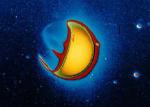
Here's a switch: the above picture is of the Earth taken from a lunar observatory! This false color picture shows how the Earth glows in ultraviolet (UV) light. UV light is so blue humans can't see it.
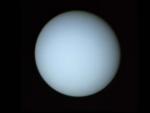 Uranus: The Tilted Planet
26.08.2001
Uranus is the third largest planet in our Solar System after Jupiter and Saturn. Uranus is composed mostly of rock and ices, but with a thick hydrogen and helium atmosphere. The blue hue of Uranus' atmosphere arises from the small amount of methane which preferentially absorbs red light.
|
January February March April May June July August |
||||||||||||||||||||||||||||||||||||||||||||||||||||||||