
|
You entered: dust
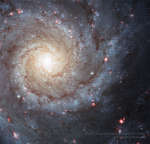 APOD: 2026 August 30 Б M74: A Grand Design Spiral
30.08.2026
If not the most grand, then this spiral galaxy is at least one of the most photogenic. An island universe of about 100 billion stars, 32 million light-years away toward the constellation Pisces, M74 presents a gorgeous face-on view.
 N81: Star Cradle in the SMC
5.10.2000
This dramatic Hubble Space Telescope image captures the birth of a cluster of massive stars. The newborn stars are seen just as they emerge from their natal nebula. Only 12 light-years across, the nebula...
 Unusual Giant Galaxy NGC 1316
16.08.2000
Can unusual giant galaxy NGC 1316 help calibrate the universe? Quite possibly -- if it turns out this atypical galaxy is composed of typical stars. NGC 1316, pictured above, is most obviously strange because...
 Orion Nebula: The 2MASS View
20.04.2002
Few astronomical sights excite the imagination like the nearby stellar nursery known as the Orion Nebula. The Nebula's glowing gas surrounds hot young stars at the edge of an immense interstellar molecular cloud only 1,500 light-years away.
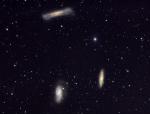 Trio Leo
9.03.2006
This popular group is famous as the Leo Triplet - a gathering of three magnificent galaxies in one field of view. Crowd pleasers when imaged with even modest telescopes, these galaxies can be introduced individually as NGC 3628 (top), M66 (bottom left), and M65 (bottom right). All three are large spiral galaxies.
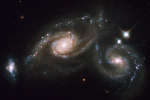 APOD: 2009 April 7 The Colliding Spiral Galaxies of Arp 274
7.04.2009
Two galaxies are squaring off in Virgo and here are the latest pictures. When two galaxies collide, the stars that compose them usually do not. This is because galaxies are mostly empty space and, however bright, stars only take up only a small fraction of that space.
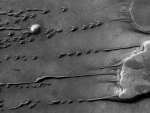 Flowing Barchan Sand Dunes on Mars
20.04.2009
When does Mars act like a liquid? Although liquids freeze and evaporate quickly into the thin atmosphere of Mars, persistent winds may make large sand dunes appear to flow and even drip like a liquid.
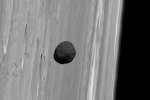 Martian Moon Phobos from Mars Express
1.12.2010
Why is Phobos so dark? Phobos, the largest and innermost of two Martian moons, is the darkest moon in the entire Solar System. Its unusual orbit and color indicate that it may be a captured asteroid composed of a mixture of ice and dark rock.
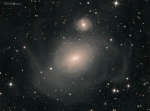 NGC 1316: After Galaxies Collide
9.09.2015
Astronomers turn detectives when trying to figure out the cause of startling sights like NGC 1316. Their investigation indicates that NGC 1316 is an enormous elliptical galaxy that started, about 100 million years ago, to devour a smaller spiral galaxy neighbor, NGC 1317, just above it.
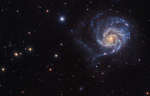 A View Toward M101
20.05.2017
Big, beautiful spiral galaxy M101 is one of the last entries in Charles Messier's famous catalog, but definitely not one of the least. About 170,000 light-years across, this galaxy is enormous, almost twice the size of our own Milky Way galaxy.
|
January February March April May June July August September |
|||||||||||||||||||||||||||||||||||||||||||||||||