
|
You entered: dark
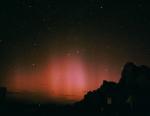 Aurora In West Texas Skies
15.09.2000
The aurora borealis, or northern lights, are not a common sight in the southwestern United States. But a strong solar coronal mass ejection in early August triggered geomagnetic storms and aurora which were widely reported, even under west Texas skies.
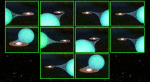 Black Hole Signature From Advective Disks
15.01.1997
What does a black hole look like? If alone, a black hole would indeed appear quite black, but many black hole candidates are part of binary star systems. So how does a black hole binary system look different from a neutron star binary system? The above drawings indicate it is difficult to tell!
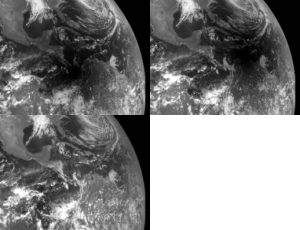 Moon Shadow
12.03.1998
When the Moon's shadow reached out and touched the Earth last month, the result was a Solar Eclipse. Such an eclipse is total only for observers located along a narrow path corresponding to the ground track of the shadow's dark central portion or "umbra".
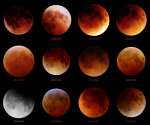 Twelve Lunar Eclipses
29.02.2008
Welcome to the extra day in the Gregorian Calendar's leap year 2008! To celebrate, consider this grid of lunar eclipse pictures - starting in leap year 1996 and ending with February's eclipse - with the date in numerical year/month/day format beneath each image.
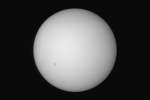 The International Space Station Transits the Sun
30.07.2008
That's no sunspot. It's the International Space Station (ISS) caught by chance passing in front of the Sun. Sunspots, individually, have a dark central umbra, a lighter surrounding penumbra, and no solar panels.
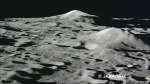 Kaguya Spacecraft Crashes into the Moon
29.06.2009
Japan's Kaguya spacecraft crashed into the Moon last week, as planned. Officially named the Selenological and Engineering Explorer (SELENE), the spacecraft was given the nickname Kaguya after the princess in the Japanese folklore story The Tale of the Bamboo Cutter.
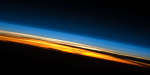 Sunset from the International Space Station
23.06.2010
What are these strange color bands being seen from the International Space Station? The Sun setting through Earth's atmosphere. Pictured above, a sunset captured last month by the ISS's Expedition 23 crew shows in vivid detail many layers of the Earth's thin atmosphere.
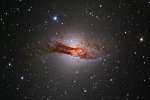 Centaurus A
4.04.2012
What's the closest active galaxy to planet Earth? That would be Centaurus A, only 11 million light-years distant. Spanning over 60,000 light-years, the peculiar elliptical galaxy is also known as NGC 5128.
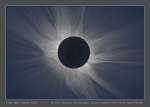 Corona from Svalbard
31.03.2015
During a total solar eclipse, the Sun's extensive outer atmosphere, or corona, is an inspirational sight. Streamers and shimmering features that engage the eye span a brightness range of over 10,000 to 1, making them notoriously difficult to capture in a single photograph.
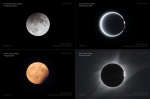 All the Eclipses of 2017
7.12.2017
As seen from planet Earth, all the lunar and solar eclipses of 2017 are represented at the same scale in these four panels. The year's celestial shadow play was followed through four different countries by one adventurous eclipse chaser.
|
January February March April May June July August September |
|||||||||||||||||||||||||||||||||||||||||||||||||