
|
You entered: constellation
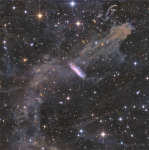 A Galaxy Beyond Stars, Gas, Dust
19.10.2022
Do we dare believe our eyes? When we look at images of space, we often wonder whether they are "real", and just as often the best answer varies. In this case, the scene appears...
 APOD: 2025 July 25 Б Twelve Years of Kappa Cygnids
25.07.2025
Meteors from the Kappa Cygnid meteor shower are captured in this time-lapse composite skyscape. The minor meteor shower, with a radiant not far from its eponymous star Kappa Cygni, peaks in mid-August, almost at the same time as the much better-known and better-observed Perseid meteor shower.
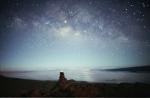 Moonlight, Mars and Milky Way
27.06.2001
Aloha and welcome to a breath-taking skyscape. In this celestial scene, a four day old Moon illuminates a dreamlike foreground while bright planet Mars (above center) rules and the Milky Way's cosmic clouds of stars and dust seem to stretch from horizon to horizon.
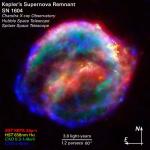 Kepler s SNR from Chandra, Hubble, Spitzer
8.10.2004
Light from the stellar explosion that created this energized cosmic cloud was first seen on planet Earth in October 1604, a mere four hundred years ago. The supernova produced a bright new star in early 17th century skies within the constellation Ophiucus.
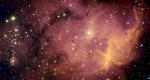 NGC 2467: From Gas to Stars
31.01.2005
One might guess that the group of stars on the left is responsible for shaping the gas cloud on the right -- but it probably is not. Observations of many of the stars...
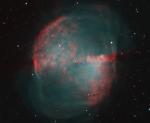 M27: Not A Comet
3.08.2006
While searching the skies above 18th century France for comets, astronomer Charles Messier diligently recorded this object as number 27 on his list of things which are definitely not comets. So what is it?
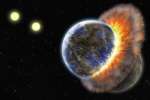 The Case of the Very Dusty Binary Star
25.09.2008
For astronomers, close binary star system BD+20 307 originally stood out because it is extremely dusty. A substantial amount of warm dust surrounding it causes the system to appear exceptionally bright at infrared wavelengths. Of course, dust associated with planet formation is often detected around young stars, stars only a few million years old.
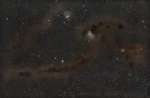 Dark Markings of the Sky
25.04.2009
Based on wide field photographs, American astronomer Edward Emerson Barnard cataloged the dark markings of the sky in the early 20th century. Barnard's markings are dark nebulae, interstellar clouds of obscuring gas and dust.
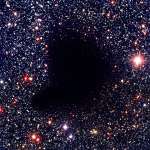 Molecular Cloud Barnard 68
23.06.2009
Where did all the stars go? What used to be considered a hole in the sky is now known to astronomers as a dark molecular cloud. Here, a high concentration of dust and molecular gas absorb practically all the visible light emitted from background stars.
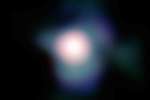 Betelgeuse Resolved
5.08.2009
The sharpest image ever of Betelgeuse shows a mammoth star that is slowly evaporating. Betelgeuse (sounds a lot like "beetle juice"), also known as Alpha Orionis, is one of the largest and brightest stars known. The star is a familiar orange fixture easily visible to the unaided eye toward the constellation of Orion.
|
January February |
|||||||||||||||||||||||||||||||||||||||||||||||||