
|
You entered: Moon
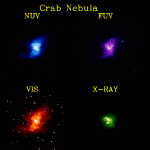 The High Energy Crab Nebula
9.09.1996
This is the mess that is left when a star explodes. The Crab Nebula is so energetic that it glows in every kind of light known. Shown above are images of the Crab Nebula from visible light to the X-ray band.
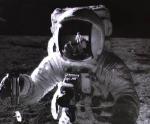 Apollo 12: Self-Portrait
15.03.2003
Is it art? In November of 1969, Apollo 12 astronaut-photographer Charles "Pete" Conrad recorded this masterpiece while documenting colleague Alan Bean's lunar soil collection activities on the Oceanus Procellarum. The image is dramatic and stark. Bean is faceless.
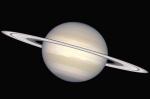 Natural Saturn On The Cassini Cruise
17.08.2003
What could you see approaching Saturn aboard an interplanetary cruise ship? Your view would likely resemble this subtly shaded image of the gorgeous ringed gas giant. Processed by the Hubble Heritage project, the picture...
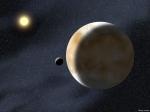 Eris: More Massive than Pluto
19.06.2007
Eris, a dwarf planet currently orbiting the Sun at about twice Pluto's distance, has been measured to have about 27 percent more mass than Pluto. The mass was calculated by timing the orbit of Eris' moon Dysnomia.
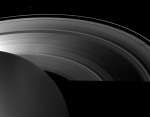 Shadows of Saturn at Equinox
1.09.2009
Unusual shadows and dark rings appeared around Saturn near its equinox last month. At that time -- early August -- Saturn's ring plane pointed directly at the Sun. Visible above, Saturn's moon Tethys casts a shadow visible only on the far right.
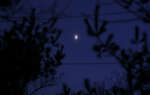 An Unusual Venusian Oval
13.02.2012
Why would Venus appear oval? Venus has been seen countless times from the surface of the Earth, and every time the Earth's atmosphere has dispersed its light to some degree. When...
 The Bubble and M52
8.10.2013
To the eye, this cosmic composition nicely balances the Bubble Nebula at the lower left with open star cluster M52 above it and to the right. The pair would be lopsided on other scales, though.
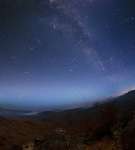 Lyrids in Southern Skies
24.04.2014
Earth's annual Lyrid meteor shower peaked before dawn on April 22nd, as our fair planet plowed through dust from the tail of long-period comet Thatcher. Even in the dry and dark Atacama desert along Chile's Pacific coast, light from a last quarter Moon made the night sky bright, washing out fainter meteor streaks.
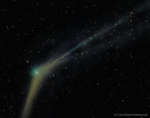 Comet Catalina Emerges
7.12.2015
Comet Catalina is ready for its close-up. The giant snowball from the outer Solar System, known formally as C/2013 US10 (Catalina), rounded the Sun last month and is now headed for its closest approach to Earth in January.
 The View Toward M101
21.01.2016
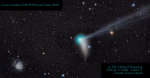
Sweeping through northern skies, Comet Catalina (C/2013 US10) made its closest approach on January 17, passing about 6 light-minutes from our fair planet. Dust and ion tails clearly separated in this Earth-based view, the comet is also posed for a Messier moment, near the line-of-sight to M101, grand spiral galaxy in Ursa Major.
|
January February March April May June July August September October |
|||||||||||||||||||||||||||||||||||||||||||||||||