
|
You entered: Earth
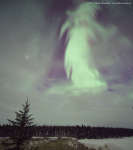 Ghost Aurora over Canada
31.10.2016
What does this aurora look like to you? While braving the cold to watch the skies above northern Canada early one morning in 2013, a most unusual aurora appeared. The aurora definitely appeared to be shaped like something , but what?
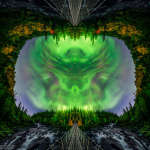 A Rorschach Aurora
30.10.2021
If you see this as a monster's face, don't panic. It's only pareidolia, often experienced as the tendency to see faces in patterns of light and shadow. In fact, the startling visual scene is actually a 180 degree panorama of Northern Lights, digitally mirrored like inkblots on a folded piece of paper.
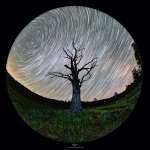 Roots on a Rotating Planet
8.07.2022
With roots on a rotating planet, an old tree is centered in this sequence of 137 exposures each 20 seconds long, recorded one night from northern Sicily. Digital camera and fisheye lens were fixed to a tripod to capture the dramatic timelapse, so the stars trailed through the region's dark sky.
 ELT and the Milky Way
16.03.2024
The southern winter Milky Way sprawls across this night skyscape. Looking due south, the webcam view was recorded near local midnight on March 11 in dry, dark skies over the central Chilean Atacama desert.
 APOD: 2024 September 1 Б The Moon Dressed Like Saturn
1.09.2024
Why does Saturn appear so big? It doesn't -- what is pictured are foreground clouds on Earth crossing in front of the Moon. The Moon shows a slight crescent phase with most of its surface visible by reflected Earthlight, known as Da Vinci glow.
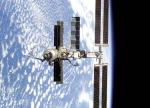 Space Station Shows Off New Robot Arm
9.05.2001
The International Space Station (ISS) continues to grow. Last month, the crew of the Space Shuttle Endeavor delivered new Logistics Modules and installed the new Canadarm2 on the growing outpost. The ISS -- complete with its new arm -- was photographed 400 kilometers above planet Earth by the Space Shuttle Endeavor crew soon after they undocked.
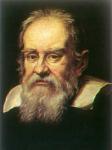 Galileo Demonstrates the Telescope
14.10.2001
Galileo Galilei made a good discovery great. Upon hearing at age 40 that a Dutch optician had invented a glass that made distant objects appear larger, Galileo crafted his own telescope and turned it toward the sky.
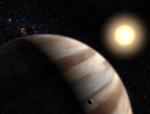 Extra Solar Planetary Atmosphere Detected
28.11.2001
By directly detecting the atmosphere of a planet outside our Solar System, humanity has taken another small step toward finding extraterrestrial life. The unexpected detection by David Charbonneau (Caltech) and associates came from Hubble Space Telescope observations of Sun-like star HD 209458.
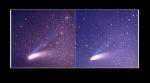 Hale-Bopp in Stereo
4.04.1997
This stereo pair of Hale-Bopp images combines two pictures from slightly different viewing angles. Simulating stereo vision, the difference was generated by the comet's apparent motion as it cruised through the inner Solar System.
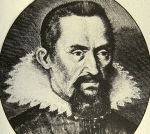 Kepler Discovers How Planets Move
13.09.1997
Johannes Kepler used simple mathematics to describe how planets move. Kepler was an assistant to the most accurate astronomical observer of the time, Tycho Brahe. Kepler was able to use Brahe's data...
|
January February March April May June July August September October |
|||||||||||||||||||||||||||||||||||||||||||||||||