
|
You entered: star
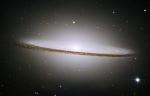 The Sombrero Galaxy from HST
15.01.2006
Why does the Sombrero Galaxy look like a hat? Reasons include the Sombrero's unusually large and extended central bulge of stars, and dark prominent dust lanes that appear in a disk that we see nearly edge-on. Billions of old stars cause the diffuse glow of the extended central bulge.
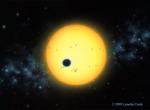 In the Shade of a Historic Planet
15.11.1999
For the first time, astronomers have recovered independent evidence that distant planetary systems exist. Last Friday, a team led by G. W. Henry (Tenn. State) and G. Marcy (UC Berkeley) announced the discovery of a shadow of a planet crossing a distant star.
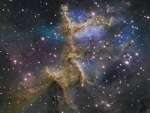 Central IC 1805
26.07.2008
Cosmic clouds seem to form fantastic shapes in the central regions of emission nebula IC 1805. Of course, the clouds are sculpted by stellar winds and radiation from massive hot stars in the nebula's newborn star cluster (aka Melotte 15).
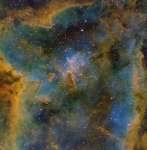 Melotte 15 in the Heart
25.09.2010
Cosmic clouds seem to form fantastic shapes in the central regions of emission nebula IC 1805. Of course, the clouds are sculpted by stellar winds and radiation from massive hot stars in the nebula's newborn star cluster, Melotte 15.
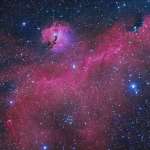 The Seagull Nebula
12.01.2011
This broad expanse of glowing gas and dust presents a bird-like visage to astronomers from planet Earth, suggesting its popular moniker - The Seagull Nebula. This portrait of the cosmic bird covers a 1.6 degree wide swath across the plane of the Milky Way, near the direction of Sirius, alpha star of the constellation Canis Major.
RGBpugh1024.preview.jpg) One Armed Spiral Galaxy NGC 4725
One Armed Spiral Galaxy NGC 4725
16.04.2015
While most spiral galaxies, including our own Milky Way, have two or more spiral arms, NGC 4725 has only one. In this sharp color composite image, the solo spira mirabilis seems to wind from a prominent ring of bluish, newborn star clusters and red tinted star forming regions.
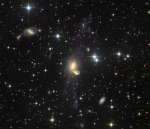 Recycling NGC 5291
21.11.2015
Following an ancient galaxy-galaxy collision 200 million light-years from Earth, debris from a gas-rich galaxy, NGC 5291, was flung far into intergalactic space. NGC 5291 and the likely interloper, also known as the "Seashell" galaxy, are captured near the center of this spectacular scene.
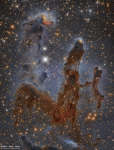 Pillars of the Eagle Nebula in Infrared
20.06.2018
Newborn stars are forming in the Eagle Nebula. Gravitationally contracting in pillars of dense gas and dust, the intense radiation of these newly-formed bright stars is causing surrounding material to boil away. This image...
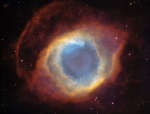 The Helix Nebula from Blanco and Hubble
23.08.2020
How did a star create the Helix nebula? The shapes of planetary nebula like the Helix are important because they likely hold clues to how stars like the Sun end their lives. Observations...
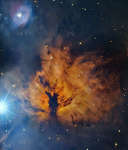 Alnitak and the Flame Nebula
12.04.2021
What lights up the Flame Nebula? Fifteen hundred light years away towards the constellation of Orion lies a nebula which, from its glow and dark dust lanes, appears, on the left, like a billowing fire. But fire, the rapid acquisition of oxygen, is not what makes this Flame glow.
|
January February March April May June July August September |
|||||||||||||||||||||||||||||||||||||||||||||||||