
|
You entered: telescope
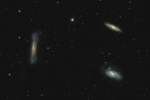 Leo Trio
12.04.2017
This group is popular in the northern spring. Famous as the Leo Triplet, the three magnificent galaxies gather in one field of view. Crowd pleasers when imaged with even modest telescopes, they can be introduced individually as NGC 3628 (left), M66 (bottom right), and M65 (top).
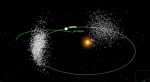 The Case of the Backwards Orbiting Asteroid
30.05.2018
Why does asteroid 2015 BZ509 orbit the Sun the backwards? As shown in the featured animation, Jupiter's trojan asteroids orbit the Sun in two major groups -- one just ahead of Jupiter, and one just behind -- but all orbit the Sun in the same direction as Jupiter.
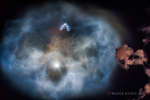 The Falcon 9 Nebula
12.10.2018
Not the Hubble Space Telescope's latest view of a distant planetary nebula, this illuminated cloud of gas and dust dazzled even casual U.S. west coast skygazers on October 7. Taken about three miles...
 APOD: 2025 March 3 Б Blue Ghost on the Moon
3.03.2025
There's a new lander on the Moon. Yesterday Firefly Aerospace's Blue Ghost executed the first-ever successful commercial lunar landing. During its planned 60-day mission, Blue Ghost will deploy several NASA-commissioned scientific instruments, including PlanetVac which captures lunar dust after creating a small whirlwind of gas.
 APOD: 2025 June 8 Б Facing NGC 3344
8.06.2025
From our vantage point in the Milky Way Galaxy, we see NGC 3344 face-on. Nearly 40,000 light-years across, the big, beautiful spiral galaxy is located just 20 million light-years away in the constellation of Leo Minor. This multi-color Hubble Space Telescope close-up of NGC 3344 includes remarkable details from near infrared to ultraviolet wavelengths.
 APOD: 2025 December 1 Б 3I ATLAS: Tails of an Interstellar Comet
1.12.2025
How typical is our Solar System? Studying 3I/ATLAS, a comet just passing through, is providing clues. Confirmed previous interstellar visitors include an asteroid, a comet, a meteor, and a gas wind dominated by hydrogen and helium.
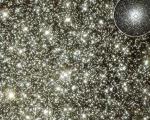 Unusual Flashes Toward Globular Cluster M22
3.07.2001
What is causing the unusual flashes behind globular cluster M22? This teaming ball of stars is the brightest globular cluster visible in Earth's northern hemisphere. M22, shown in full in the inset, spans about 50 light years away and lies 8500 light-years toward the constellation of Sagittarius.
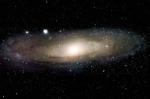 Andromeda Island Universe
18.05.2002
How far can you see? The most distant object easily visible to the unaided eye is M31, the great Andromeda Galaxy some two million light-years away. Without a telescope, even this immense spiral galaxy appears as an unremarkable, faint, nebulous cloud in the constellation Andromeda.
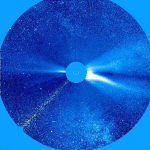 Solar Wind And Milky Way
4.03.1997
The Sun is bright, so bright that it overwhelms the light from other stars even for most satellite-borne telescopes. But LASCO, a coronograph onboard the space-based SOHO Observatory, uses occulting disks to block the intense solar light and examine the tenuous, hot gases millions of miles above the Sun's surface.
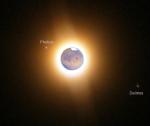 Mars Moons
24.10.2003
This year's record close approach of Mars inspired many to enjoy telescopic views of the red planet. But while Mars was so bright it was hard to miss, spotting Mars' two diminutive moons was still a good test for observers with modest sized instruments.
|
January February March April May |
|||||||||||||||||||||||||||||||||||||||||||||||||