
|
You entered: rings
 Finding Dark Matter
19.12.2001
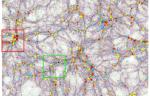
Where is dark matter? Galaxies rotate and move in clusters as if a tremendous amount of unseen matter is present. But does dark matter exist in the greater universe too -- and if so, where? The answer can be found by comparing the distribution of galaxies observed with numerical simulations.
 A Spectre in the Eastern Veil
1.11.2008
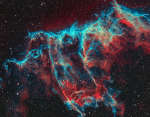
Menacing flying forms and garish colors are a mark of the Halloween season. They also stand out in this cosmic close-up of the eastern Veil Nebula. The Veil Nebula itself is a large supernova remnant, the expanding debris cloud from the death explosion of a massive star.
 IC 410 and NGC 1893
17.01.2009
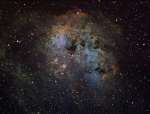
Dusty emission nebula IC 410 lies about 12,000 light-years away in the northern constellation Auriga. The cloud of glowing gas is over 100 light-years across, sculpted by stellar winds and radiation from embedded open star cluster NGC 1893.
 Mars in a Manger
30.04.2010
At opposition in late January, Mars shone very brightly in planet Earth's night sky, among the stars of the constellation Cancer the Crab. Since then the Red Planet has been fading, but still lingers in Cancer during April and May.
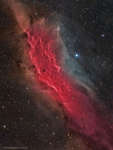 The California Nebula
12.01.2016
What's California doing in space? Drifting through the Orion Arm of the spiral Milky Way Galaxy, this cosmic cloud by chance echoes the outline of California on the west coast of the United States.
 NGC 6995: The Bat Nebula
27.10.2021
Do you see the bat? It haunts this cosmic close-up of the eastern Veil Nebula. The Veil Nebula itself is a large supernova remnant, the expanding debris cloud from the death explosion of a massive star.
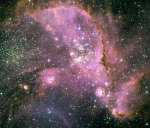 Young Stars of NGC 346
12.05.2022
The massive stars of NGC 346 are short lived, but very energetic. The star cluster is embedded in the largest star forming region in the Small Magellanic Cloud, some 210,000 light-years distant. Their...
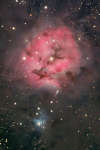 IC 5146: The Cocoon Nebula
27.08.2022
Inside the Cocoon Nebula is a newly developing cluster of stars. Cataloged as IC 5146, the beautiful nebula is nearly 15 light-years wide. Climbing high in northern summer night skies, it's located some 4,000 light years away toward the constellation Cygnus the Swan.
 APOD: 2025 May 13 Б Gaia Reconstructs a Top View of our Galaxy
13.05.2025
What does our Milky Way Galaxy look like from the top? Because we are on the inside, humanity canБt get an actual picture. Recently, however, just such a map has been made using location data for over a billion stars from ESAБs Gaia mission.
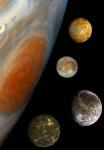 Jupiter And Family
18.11.2000
This composite image features classic portraits of members of one of the Solar System's most prominent families - Jupiter and its four large "Galilean" moons. Starting from the top the moons are Io, Europa, Ganymede, and Callisto. The top-to-bottom order is also the order of increasing distance from Jupiter.
|
January February March April May |
|||||||||||||||||||||||||||||||||||||||||||||||||