
|
You entered: Earth
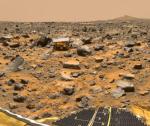 At Work on Mars
14.07.1998
To learn about the history ofMars, just ask the rocks. Last year, that's exactly what the robot rover Sojourner did. Sojouner can be seen, above, analyzing a rock nicknamed Moe, trying to discern its past.
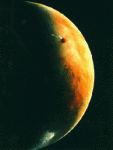 Barsoom
24.04.1999
"Yes, I have been to Barsoom again ..." begins John Carter in Edgar Rice Burroughs' 1913 science fiction classic "The Gods of Mars". In Burroughs' novels describing Carter's adventures on Mars, "Barsoom" is the local inhabitants' name for the Red Planet. Long after Burroughs' stories were published, Mars continues to inspire Earthdwellers' interests and imagination.
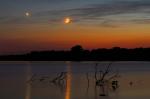 Planets over Pony Express Lake
18.07.2007
Beautiful sunset sky colors are reflected in Pony Express Lake in this twilight skyview from northern Missouri, USA, planet Earth. Recorded on Monday, a two day old crescent Moon and brilliant planet Venus shine through thin clouds.
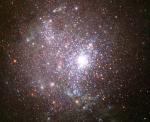 The Stars of NGC 1705
23.04.2003
Some 2,000 light-years across, NGC 1705 is small as galaxies go, similar to our Milky Way's own satellite galaxies, the Magellanic Clouds. At a much larger distance of 17 million light-years...
 Meteors, Planes, and a Galaxy over Bryce Canyon
19.05.2014
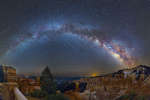
Sometimes land and sky are both busy and beautiful. The landscape pictured in the foreground encompasses Bryce Canyon in Utah, USA, famous for its many interesting rock structures eroded over millions of years.
 ISON, Mars, Regulus
17.10.2013
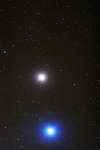
In order top to bottom this celestial snapshot features Comet ISON, planet Mars, and Regulus, alpha star of the constellation Leo, in the same frame. The scene spans about 2 degrees near the eastern horizon in early morning skies of October 15.
 Pictured: An Ancient Martian?
8.08.1996
Alien! Alien? Is this what an ancient Martian looked like? The tube-like form on the above highly magnified image is now believed by many to be a fossil of a simple Martian organism that lived over 3.6 billion years ago.
 Cassini to Venus
3.07.2004
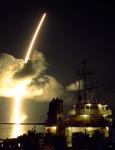
Saturn Orbiter Cassini with Titan Probe Huygens attached rocketed into early morning skies on October 15, 1997. The mighty Titan 4B Centaur rocket is seen here across the water, arcing away from Launch Complex 40 at Cape Canaveral Air Station.
 Venus and Comet Pojmanski
3.03.2006
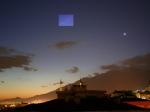
Shining brightly in the east at dawn, Venus dominates the sky in this view over a suburban landscape from Bursa, Turkey. An otherwise familiar scene for astronomer Tunc Tezel, his composite picture of the morning sky recorded on March 2nd also includes a surprise visitor to the inner solar system, Comet Pojmanski.
 Geminid Meteor Shower over Dashanbao Wetlands
13.12.2013
The annual Geminid meteor shower is raining down on planet Earth this week. And despite the waxing gibbous moonlight, the reliable Geminids should be enjoyable tonight (night of December 13/14) near the shower's peak.
|
January February March April May June July August September October |
|||||||||||||||||||||||||||||||||||||||||||||||||