
|
You entered: southern sky
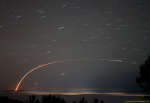 OCO 2 Night Launch
4.07.2014
In this alluring time exposure, star trails arc across the night sky above foggy Monterey Bay and the lights of Santa Cruz, California in the United States of America. Since the exposure began around...
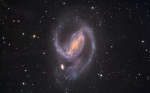 In the Arms of NGC 1097
8.01.2015
Spiral galaxy NGC 1097 shines in southern skies, about 45 million light-years away in the chemical constellation Fornax. Its blue spiral arms are mottled with pinkish star forming regions in this colorful galaxy portrait.
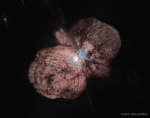 Doomed Star Eta Carinae
27.12.2015
Eta Carinae may be about to explode. But no one knows when - it may be next year, it may be one million years from now. Eta Carinae's mass - about 100 times greater than our Sun - makes it an excellent candidate for a full blown supernova.
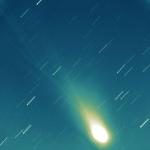 Tails Of Comet LINEAR
27.07.2000
Comet C/1999 S4 LINEAR is only one of many comets discovered with the Lincoln Near Earth Asteroid Research (LINEAR) telescope operating near Soccoro, New Mexico, USA. Traveling steadily southward through Earth's night...
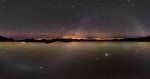 A Tale of Two Hemispheres
30.07.2011
A quest to find planet Earth's darkest night skies led to this intriguing panorama. In projection, the mosaic view sandwiches the horizons visible in all-sky images taken from the northern hemisphere's Canary Island of La Palma (top) and the south's high Atacama Desert between the two hemispheres of the Milky Way Galaxy.
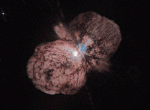 Doomed Star Eta Carinae
12.07.1997
Eta Carinae may be about to explode. But no one knows when - it may be next year, it may be one million years from now. Eta Carinae's mass - about 100 times greater than our Sun - make it an excellent candidate for a full blown supernova.
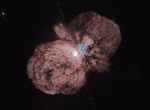 Doomed Star Eta Carinae
11.06.1996
Eta Carinae may be about to explode. But no one knows when - it may be next year, it may be one million years from now. Eta Carinae's mass - about 100 times greater than our Sun - make it an excellent candidate for a full blown supernova.
 The Tarantula Zone
26.04.2008
The Tarantula Nebula is more than 1,000 light-years in diameter -- a giant star forming region within our neighboring galaxy the Large Magellanic Cloud (LMC). That cosmic arachnid lies at the upper left of this expansive mosiac covering a part of the LMC over 6,000 light-years across.
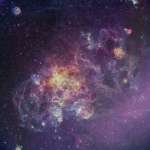 The Tarantula Zone
16.09.2009
The Tarantula Nebula is more than 1,000 light-years in diameter -- a giant star forming region within our neighboring galaxy the Large Magellanic Cloud (LMC). That cosmic arachnid lies left of center in this in this colorful telescopic image taken through narrow-band filters. It covers a part of the LMC over 2,000 light-years across.
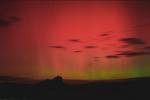 Aurora in Colorado Skies
30.10.2003
Vivid auroral displays were triggered by a cloud of high energy particles from the Sun that collided with planet Earth's magnetosphere yesterday, October 29, at about 06:30 Universal Time. The collision...
|
January February March April May |
|||||||||||||||||||||||||||||||||||||||||||||||||