
|
You entered: satellite
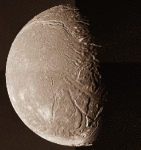 Uranus' Moon Ariel: Valley World
3.03.1996
What formed Ariel's valleys? This question presented itself when Voyager 2 passed this satellite of Uranus in January 1986. Speculation includes that heating caused by the ancient tides of Uranus caused moonquakes and massive shifting of the moon's surface.
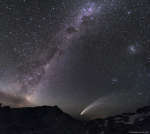 Three Galaxies and a Comet
14.01.2018
Diffuse starlight and dark nebulae along the southern Milky Way arc over the horizon and sprawl diagonally through this gorgeous nightscape. The breath-taking mosaic spans a wide 100 degrees, with the rugged terrain of the Patagonia, Argentina region in the foreground.
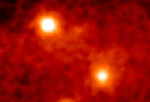 Gamma Ray Crab, Geminga
24.06.1995
What if you could "see" in gamma-rays? If you could, these two spinning neutron stars or pulsars would be among the brightest objects in the sky. This computer processed image shows the Crab Nebula pulsar (below and right of center) and the Geminga pulsar (above and left of center) in the "light" of gamma-rays.
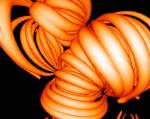 Solar Magnetic Bananas
29.06.1998
Is that our Sun? The unusual banana-shaped loops shown above are actually part of a computer-generated snap-shot of our Sun's magnetic field. This animated frame was constructed using data from the ground-based U.S. Solar Vector Magnetograph and the space-based Japanese X-Ray Telescope Yohkoh.
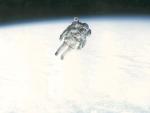 To Fly Free in Space
24.09.2002
What would it be like to fly free over the seas and clouds of Earth? The first to experience such an "untethered space walk" were NASA astronauts Bruce McCandless and Robert Stewart during Space Shuttle mission 41-B in 1984.
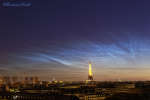 Noctilucent Clouds over Paris
12.07.2022
It's northern noctilucent cloud season. Composed of small ice crystals forming only during specific conditions in the upper atmosphere, noctilucent clouds may become visible at sunset during late summer when illuminated by sunlight from below. Noctilucent clouds are the highest clouds known and now established to be polar mesospheric clouds observed from the ground.
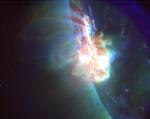 An Active Region of the Sun
16.06.1998
The Sun is a busy place. This false-color image depicts an active region near an edge of the Sun. Hot plasma is seen exploding off the Sun's photosphere and traveling along loops defined by the Sun's magnetic field.
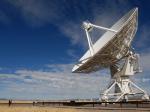 A Big Dish at the VLA Radio Observatory
29.11.2006
They are so large, they are almost unreal. The radio dishes of the Very Large Array (VLA) of radio telescopes might appear to some as a strange combination of a dinosaur skeleton and common satellite-TV receiving dish.
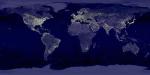 Earth at Night
27.11.2000
This is what the Earth looks like at night. Can you find your favorite country or city? Surprisingly, city lights make this task quite possible. Human-made lights highlight particularly developed or populated areas of the Earth's surface, including the seaboards of Europe, the eastern United States, and Japan.
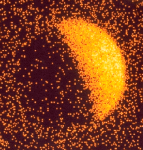 The X-Ray Moon
29.09.1996
This X-Ray image of the Moon was made by the orbiting Roentgen Observatory Satellite (ROSAT) in 1990. It shows three distinct regions: a bright X-ray sky, a bright part of the Moon, and a relatively dark part of the Moon. The bright X-ray sky is due to the diffuse cosmic X-ray background.
|
January February |
|||||||||||||||||||||||||||||||||||||||||||||||||