
|
You entered: night sky
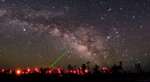 Messier Marathon
27.05.2011
In this action scene, red night vision lights, green laser pointers, tripods and telescopes in faint silhouette surround intrepid sky gazers embarked on the 10th annual Iran Messier Marathon. Completing the marathon requires viewing all 110 objects in 18th century French astronomer Charles Messier's catalog in one glorious dusk-to-dawn observing run.
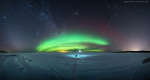 A Symphony in Northern Winter Skies
22.03.2019
Despite the cold, a chance to view the shimmering northern lights coaxed this skygazer onto the frozen surface of Lake Superior on the west coast of the Keweenaw Peninusla and offered this nocturnal crescendo as a reward.
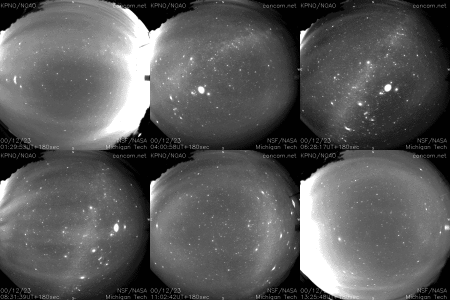 Watch the Sky Rotate
10.01.2001
If you could watch the sky for an entire night, what would you see? The above time-lapse sequence from the CONtinuous CAMera (CONCAM) project shows the answer for the skies above Kitt Peak National Observatory on 2000 December 23.
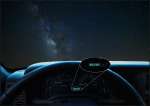 The Mileage of Light
28.05.2011
If you're driving down a dark road on a starry night, you might want to check the odometer. Earlier this month, when traveling astronomer Dennis Mammana did he was greeted with the significant mileage reading of 186,282 miles. That's the number of miles light travels in one second.
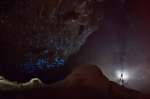 The Starry Sky under Hollow Hill
30.08.2014
Look up in New Zealand's Hollow Hill Cave and you might think you see a familiar starry sky. And that's exactly what Arachnocampa luminosa are counting on. Captured in this long exposure...
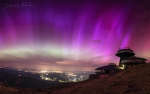 APOD: 2024 June 12 Б Aurora over Karkonosze Mountains
12.06.2024
It was the first time ever. At least, the first time this photographer had ever seen aurora from his home mountains. And what a spectacular aurora it was. The Karkonosze Mountains in Poland are usually too far south to see any auroras.
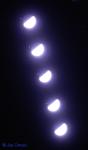 Regulus Occulted
2.08.1999
On May 21, viewed from the continental US, a star winked out as it passed behind the dark limb of the first-quarter Moon. The star, Regulus, is hotter than the sun, about 69 light-years distant, and shines in Earth's skies as the brightest star in the constellation Leo, the Lion.
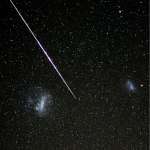 Meteor between the Clouds
20.11.2009
This bright meteor streaked through dark night skies over Sutherland, South Africa on November 15. Potentially part of the annual Leonid meteor shower, its sudden, brilliant appearance, likened to a camera's flash, was captured by chance as it passed between two clouds.
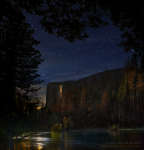 Firefall by Moonlight
8.06.2017
On certain dates in February, an elusive firefall can be spotted at sunset in Yosemite National Park, when the weather cooperates and the direction to the setting Sun is just right. Often photographed from...
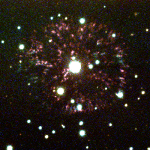 The Firework Nebula
4.07.1998
Imaged by the WIYN Telescope, the Firework Nebula is the result of a type of stellar explosion called a nova. In a nova, a nuclear detonation on the surface of a compact white dwarf star blasts away material that has been dumped on its surface by a companion star.
|
January February March April May June July August September |
|||||||||||||||||||||||||||||||||||||||||||||||||