
|
You entered: massive stars
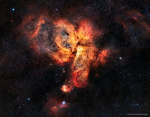 The Great Nebula in Carina
12.06.2017
In one of the brightest parts of Milky Way lies a nebula where some of the oddest things occur. NGC 3372, known as the Great Nebula in Carina, is home to massive stars and changing nebulas.
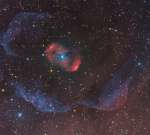 A Halo for NGC 6164
22.05.2014
Beautiful emission nebula NGC 6164 was created by a rare, hot, luminous O-type star, some 40 times as massive as the Sun. Seen at the center of the cosmic cloud, the star is a mere 3 to 4 million years old.
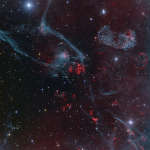 Puppis A Supernova Remnant
28.09.2017
Driven by the explosion of a massive star, supernova remnant Puppis A is blasting into the surrounding interstellar medium about 7,000 light-years away. At that distance, this colorful telescopic field based on broadband and narrowband optical image data is about 60 light-years across.
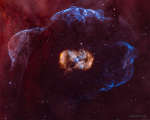 NGC 6164: Dragons Egg Nebula and Halo
25.12.2022
The star at the center created everything. Known as the Dragon's Egg, this star -- a rare, hot, luminous O-type star some 40 times as massive as the Sun -- created not only the complex nebula (NGC 6164) that immediately surrounds it, but also the encompassing blue halo.
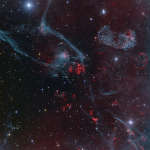 Puppis A Supernova Remnant
27.08.2015
Driven by the explosion of a massive star, supernova remnant Puppis A is blasting into the surrounding interstellar medium about 7,000 light-years away. At that distance, this colorful telescopic field based on broadband and narrowband optical image data is about 60 light-years across.
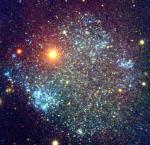 Sextans A: A Seemingly Square Galaxy
2.11.1998
What's bothering local galaxy Sextans A? A small dwarf irregular galaxy spanning 5 thousand light years across, Sextans A is located only 5 million light-years away. Named for its home constellation of Sextans, the "diamond in the rough" structure relates to an ancient unknown event.
 APOD: 2024 June 10 Б Sh2 132: The Lion Nebula
9.06.2024
Is the Lion Nebula the real ruler of the constellation Cepheus? This powerful feline appearing nebula is powered by two massive stars, each with a mass over 20 times greater than our Sun. Formed...
 APOD: 2025 October 28 Б NGC 6995: The Bat Nebula
27.10.2025
Can you see the bat? It haunts this cosmic close-up of the eastern Veil Nebula. The Veil Nebula itself is a large supernova remnant, the expanding debris cloud from the death explosion of a massive star.
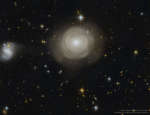 Shells of Stars in Elliptical Galaxy PGC 42871
28.10.2018
How do galaxies grow? To help find out, the Hubble Space Telescope was deployed to image the unusual elliptical galaxy PGC 42871. How this galaxy came to be surrounded by numerous shells of stars may give clues about how it evolved.
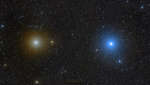 Gemini Stars Pollux and Castor
15.05.2017
Who are the twins of Gemini? It terms of astronomical objects, the famous constellation is dominated by two bright stars: Pollux (left) and Castor (right). Pictured, the two stars stand out because they are so bright, so close together both in angle and brightness, but so different in color.
|
January February March April May |
|||||||||||||||||||||||||||||||||||||||||||||||||