
|
You entered: impact crater
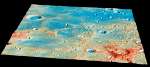 MESSENGER s Last Day on Mercury
1.05.2015
The first to orbit Mercury, the MESSENGER spacecraft came to rest on this region of Mercury's surface yesterday. Constructed from MESSENGER image and laser altimeter data, the scene looks north over the northeastern rim of the broad, lava filled Shakespeare basin.
 MESSENGER s Last Day on Mercury
1.05.2025
The first to orbit inner planet Mercury, the MESSENGER spacecraft came to rest on this region of Mercury's surface on April 30, 2015. Constructed from MESSENGER image and laser altimeter data, the projected scene looks north over the northeastern rim of the broad, lava filled Shakespeare basin.
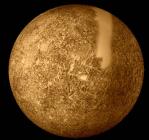 Mariner s Mercury
24.11.2001
Mercury, the closest planet to the Sun, remains the most mysterious of the Solar System's inner planets. Hiding in the Sun's glare it is a difficult target for Earth bound observers.
 Mariner's Mercury
17.12.1996
Mercury, the closest planet to the Sun, remains the most mysterious of the Solar System's inner planets. Hiding in the Sun's glare it is a difficult target for Earth bound observers.
 Mariner's Mercury
6.09.1998
Mercury, the closest planet to the Sun, remains the most mysterious of the Solar System's inner planets. Hiding in the Sun's glare it is a difficult target for Earth bound observers.
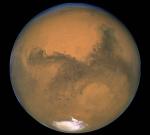 Big Mars from Hubble
27.08.2003
At about 10 am Universal Time today, Mars and Earth will pass closer than in nearly 60,000 years. Mars, noticeably red, will be the brightest object in the eastern sky just after sunset.
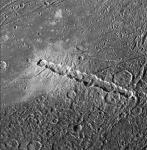 Ganymede: Torn Comet Crater Chain
15.12.2001
This striking line of 13 closely spaced craters on Jupiter's moon Ganymede was photographed by the Galileo spacecraft in 1997. The picture covers an area about 120 miles wide and the chain of craters cuts across a sharp boundary between dark and light terrain. What caused this crater chain?
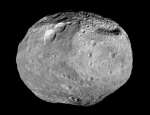 Leaving Vesta
19.09.2012
Next stop: Ceres. Last week the robotic Dawn spacecraft ended its year-long mission to asteroid Vesta, becoming the first spacecraft ever to visit this far off world located between Mars and Jupiter, in the Solar System's main asteroid belt.
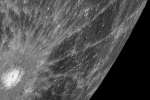 A Spectacular Rayed Crater on Mercury
3.11.2008
Why does Mercury have so many rayed craters? No one is sure. The robotic MESSENGER spacecraft that is taking unprecedented images as it swoops past the innermost planet has provided dramatic confirmation that Mercury has more rayed craters than Earth's Moon.
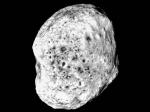 Hyperion: Sponge Moon of Saturn
26.07.2005
Why is Saturn's moon Hyperion textured like a sponge? Recent high-resolution images from the robot Cassini spacecraft orbiting Saturn show Hyperion to be an even stranger place than thought before. Previously, it was known that the length of a day on Hyperion is unpredictable.
|
January February March April May June July August September |
|||||||||||||||||||||||||||||||||||||||||||||||||