
|
You entered: group of galaxies
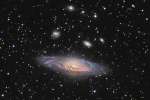 NGC 7331 and Beyond
1.03.2014
Big, beautiful spiral galaxy NGC 7331 is often touted as an analog to our own Milky Way. About 50 million light-years distant in the northern constellation Pegasus, NGC 7331 was recognized early on as a spiral nebula and is actually one of the brighter galaxies not included in Charles Messier's famous 18th century catalog.
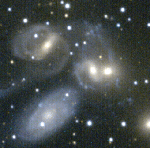 A Quintet of Galaxies
15.11.1995
Five closely grouped galaxies are visible in this image made using the Kitt Peak National Observatory 2.1 meter telescope. The grouping is commonly known as Stephan's Quintet. Four of the galaxies show essentially the same redshift suggesting that they are at the same distance from us.
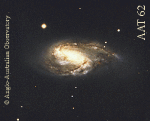 Unusual Spiral Galaxy M66
10.08.1996
Spiral galaxy M66 is largest galaxy in the a group known as the Leo Triplet. M66 is somewhat peculiar because of its asymmetric spiral arms. Usually dense waves of gas, dust, and newly formed stars - called spiral density waves - circle a galactic center and create a symmetric galaxy.
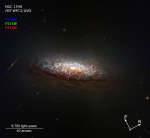 Hubble s NGC 1546
21.06.2024
Returning to science operations on June 14, the Hubble Space Telescope used its new pointing mode to capture this sharp image of spiral galaxy NGC 1546. A member of the Dorado galaxy group, the island universe lies a mere 50 million light-years away.
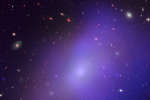 Elliptical Galaxy NGC 1132
13.02.2008
NGC 1132 is one smooth galaxy -- but how did it form? As an elliptical galaxy, NGC 1132 has little dust and gas, and few stars have formed in it recently. Although many elliptical galaxies are in clusters of galaxies, NGC 1132 appears as a large, isolated galaxy toward the constellation of the River (Eridanus).
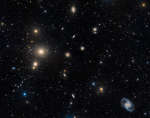 The Fornax Cluster of Galaxies
11.01.2013
How do clusters of galaxies form and evolve? To help find out, astronomers continue to study the second closest cluster of galaxies to Earth: the Fornax cluster, named for the southern constellation toward which most of its galaxies can be found.
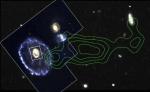 The Trail of the Intruder
24.02.1997
In yesterday's episode our hero, the Cartwheel galaxy, had survived a chance cosmic collision with a small intruder galaxy - triggering an expanding ring of star formation. Hot on the intruder's trail, a team of multiwavelength sleuths have compiled evidence tracking the reckless galaxy fleeing the scene.
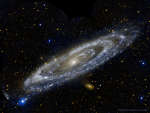 The Andromeda Galaxy in Ultraviolet
18.07.2021
What does the Andromeda galaxy look like in ultraviolet light? Young blue stars circling the galactic center dominate. A mere 2.5 million light-years away, the Andromeda Galaxy, also known as M31, really is just next door as large galaxies go.
 NGC 7331 and Beyond
14.09.2023
Big, beautiful spiral galaxy NGC 7331 is often touted as an analog to our own Milky Way. About 50 million light-years distant in the northern constellation Pegasus, NGC 7331 was recognized early on as a spiral nebula and is actually one of the brighter galaxies not included in Charles Messier's famous 18th century catalog.
 APOD: 2023 August 29 Б Unusual Spiral Galaxy M66 from Webb
29.08.2023
Why isn't spiral galaxy M66 symmetric? Usually, density waves of gas, dust, and newly formed stars circle a spiral galaxy's center and create a nearly symmetric galaxy. The differences between...
|
January February March April May June July August September |
|||||||||||||||||||||||||||||||||||||||||||||||||