
|
You entered: dust
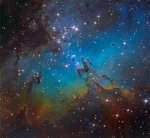 M16 Close Up
9.09.2021
A star cluster around 2 million years young surrounded by natal clouds of dust and glowing gas, M16 is also known as The Eagle Nebula. This beautifully detailed image of the region adopts the colorful Hubble palette and includes cosmic sculptures made famous in Hubble Space Telescope close-ups of the starforming complex.
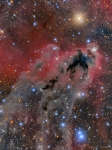 APOD: 2023 January 25 Б LDN 1622: The Boogeyman Nebula
25.01.2023
To some, the dark shape looks like a mythical boogeyman. Scientifically, Lynds' Dark Nebula (LDN) 1622 appears against a faint background of glowing hydrogen gas only visible in long telescopic exposures of the region.
 The Great Globular Cluster in Hercules
26.09.2024
In 1716, English astronomer Edmond Halley noted, "This is but a little Patch, but it shows itself to the naked Eye, when the Sky is serene and the Moon absent." Of course...
 APOD: 2024 October 30 Б NGC 7635: The Bubble Nebula
30.10.2024
What created this huge space bubble? Blown by the wind from a star, this tantalizing, head-like apparition is cataloged as NGC 7635, but known simply as the Bubble Nebula. The featured striking view utilizes a long exposure to reveal the intricate details of this cosmic bubble and its environment.
 APOD: 2024 November 4 Б M42: The Great Nebula in Orion
4.11.2024
The Great Nebula in Orion, an immense, nearby starbirth region, is probably the most famous of all astronomical nebulas. Here, glowing gas surrounds hot young stars at the edge of an immense interstellar molecular cloud only 1500 light-years away.
 APOD: 2025 January 6 Б Colliding Spiral Galaxies from Webb and Hubble
6.01.2025
Billions of years from now, only one of these two galaxies will remain. Until then, spiral galaxies NGC 2207 and IC 2163 will slowly pull each other apart, creating tides of matter, sheets of shocked gas, lanes of dark dust, bursts of star formation, and streams of cast-away stars.
 APOD: 2025 June 1 Б UGC 1810: Wildly Interacting Galaxy from Hubble
1.06.2025
What's happening to this spiral galaxy? Although details remain uncertain, it surely has to do with an ongoing battle with its smaller galactic neighbor. The featured galaxy is labelled UGC 1810 by itself, but together with its collisional partner is known as Arp 273.
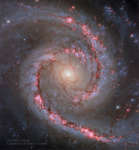 APOD: 2026 March 16 Б NGC 1566: The Spanish Dancer Galaxy
16.03.2026
If not perfect, then this spiral galaxy is at least one of the most photogenic. An island universe containing billions of stars and situated about 40 million light-years away toward the constellation of the Dolphinfish (Dorado), NGC 1566 presents a gorgeous face-on view.
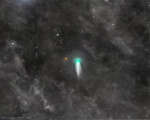 APOD: 2026 August 24 Б Comet 220P in Outburst
24.08.2026
Comet 220P is unexpectedly bright. Normally, periodic Comet 220P/McNaught is so dim that to see it requires a telescope. Two surprising outbursts this year, however, have made it about 20,000 times brighter than usual, so that it is now visible with binoculars and long-duration camera exposures.
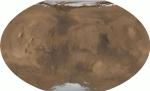 All of Mars
26.06.2001
From pole to pole, from east to west, this is all of Mars. The above picture was digitally reconstructed from over 200 million laser altimeter measurements taken by the Mars Global Surveyor spacecraft currently orbiting Mars.
|
January February March April May June July August September |
|||||||||||||||||||||||||||||||||||||||||||||||||