
|
You entered: rings
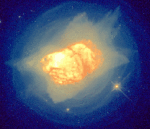 NGC 7027: A Dying Star's Nebula
17.01.1996
This pseudo-color composite of two recent Hubble Space Telescope images is a picture of a Sun-like star nearing the end of its lifetime. The exquisite details visible in this planetary nebula indicate that when...
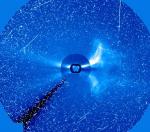 SOHO Composite: Coronal Mass Ejection
20.08.1998
This complex composite image of an ominous and spectacular event - an expanding storm of energetic particles from the Sun - was constructed using data recorded by the SOHO spacecraft on November 6, 1997. Four images...
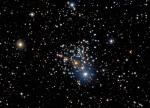 NGC 2266: Old Cluster in the New General Catalog
19.03.2005
The New General Catalog of star clusters and nebulae really isn't so new. In fact, it was published in 1888 - an attempt by J. L. E. Dreyer to consolidate the work of astronomers William, Caroline, and John Herschel along with others into a useful single, complete catalog of astronomical discoveries and measurements.
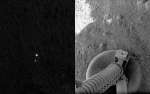 Phoenix at Mars
27.05.2008
The Phoenix lander's footpads are about the size of a dinner plate. One of three is shown at the right, covered with Martian soil after a successful soft landing on the Red Planet on May 25.
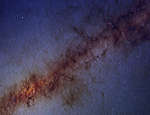 The Galactic Center in Infrared from 2MASS
30.05.2010
The center of our Galaxy is a busy place. In visible light, much of the Galactic Center is obscured by opaque dust. In infrared light, however, dust glows more and obscures less, allowing nearly one million stars to be recorded in the above image.
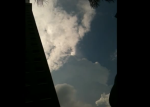 Jumping Sundogs Over Thunderclouds
8.11.2011
What's happening above those clouds? In the past few years, videos have appeared on the web detailing an unusual but little known phenomenon: rapid light changes over clouds. Upon inspection and contemplation, a leading hypothesis for its cause has now emerged.
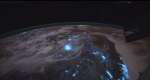 Flying Over the Earth at Night
31.03.2013
Many wonders are visible when flying over the Earth at night. A compilation of such visual spectacles was captured recently from the International Space Station (ISS) and set to rousing music. Passing below are white clouds, orange city lights, lightning flashes in thunderstorms, and dark blue seas.
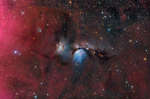 M78 Wide Field
29.12.2017
Interstellar dust clouds and glowing nebulae abound in the fertile constellation of Orion. One of the brightest, M78, is centered in this colorful, wide field view, covering an area north of Orion's belt. At a distance of about 1,500 light-years, the bluish reflection nebula is around 5 light-years across.
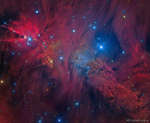 In the Vicinity of the Cone Nebula
16.04.2019
Strange shapes and textures can be found in neighborhood of the Cone Nebula. The unusual shapes originate from fine interstellar dust reacting in complex ways with the energetic light and hot gas being expelled by the young stars.
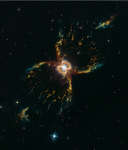 The Shape of the Southern Crab
24.04.2019
The symmetric, multi-legged appearance of the Southern Crab Nebula is certainly distinctive. About 7,000 light-years distant toward the southern sky constellation Centaurus, its glowing nested hourglass shapes are produced by the remarkable symbiotic binary star system at its center.
|
January February March April May |
|||||||||||||||||||||||||||||||||||||||||||||||||