
|
You entered: gas
 APOD: 2025 December 1 Б 3I ATLAS: Tails of an Interstellar Comet
1.12.2025
How typical is our Solar System? Studying 3I/ATLAS, a comet just passing through, is providing clues. Confirmed previous interstellar visitors include an asteroid, a comet, a meteor, and a gas wind dominated by hydrogen and helium.
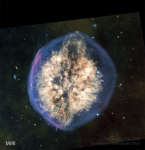 APOD: 2026 March 9 Б The Cranium Nebula from the Webb Telescope
9.03.2026
What's going on inside the head of this nebula? Dubbed the Exposed Cranium Nebula for its similarity to the human brain, what created the nebula remains a mystery. One thought is that the Cranium Nebula, also known as PMR 1, is a planetary nebula surrounding a white dwarf star.
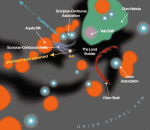 The Local Bubble and the Galactic Neighborhood
17.02.2002
What surrounds the Sun in this neck of the Milky Way Galaxy? Our current best guess is depicted in the above map of the surrounding 1500 light years constructed from various observations and deductions.
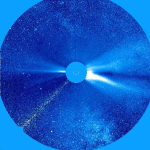 Solar Wind And Milky Way
4.03.1997
The Sun is bright, so bright that it overwhelms the light from other stars even for most satellite-borne telescopes. But LASCO, a coronograph onboard the space-based SOHO Observatory, uses occulting disks to block the intense solar light and examine the tenuous, hot gases millions of miles above the Sun's surface.
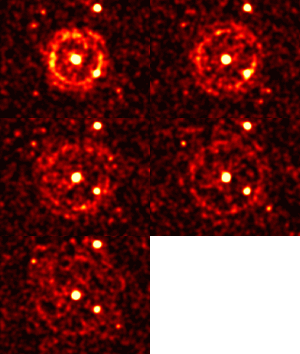 X Ray Rings Expand from a Gamma Ray Burst
30.01.2004
Why do x-ray rings appear to emanate from a gamma-ray burst? The surprising answer has little to do with the explosion itself but rather with light reflected off sheets of dust-laden gas in our own Milky Way Galaxy.
 Stars Forming in Serpens
31.08.2007
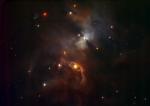
Stars are forming in a dense molecular cloud a mere 1,000 light-years away in the constellation Serpens Cauda (The Serpent's Tail). At that estimated distance, this sharp, near-infrared close-up of the active Serpens star-forming region spans about 2 arcminutes or just over half a light-year.
 Simeis 147: Supernova Remnant
31.01.2009
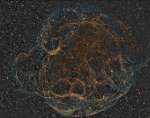
It's easy to get lost following the intricate filaments in this detailed image of faint supernova remnant Simeis 147. Also cataloged as Sh2-240 and seen towards the constellation Taurus, it covers nearly 3 degrees (6 full moons) on the sky.
 The Seagull Nebula
27.03.2009
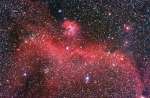
Images from two different cameras, a digital SLR and an astronomical ccd camera, are combined in this color starscape. Both cameras made use of the same telescope at the oceanside Winter Star Party in the Florida Keys, appropriately creating this portrait of the Seagull Nebula.
 Seagull to Sirius
15.12.2016
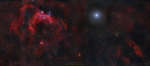
This broad, beautiful mosaic spans almost 20 degrees across planet Earth's sky. The nebula-rich region lies near the edge of the Orion-Eridanus supperbubble, filled with looping, expanding shells of gas and dust embedded in molecular clouds near the plane of the Milky Way Galaxy.
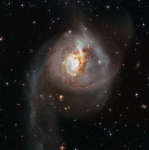 The Clash of NGC 3256
7.06.2018
Marked by an unusually bright central region, swirling dust lanes, and far flung tidal tails, peculiar NGC 3256 is the aftermath of a truly cosmic collision. The 500 million year old clash of two separate galaxies spans some 100 thousand light-years in this sharp Hubble view.
|
January February March April May |
|||||||||||||||||||||||||||||||||||||||||||||||||