
|
You entered: star cluster
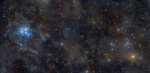 Pleiades to Hyades
17.11.2011
This cosmic vista stretches almost 20 degrees across the gentle constellation Taurus. It begins at the Pleiades and ends at the Hyades, two of the best known star clusters in planet Earth's sky. At left, the lovely Pleiades star cluster is about 400 light-years away.
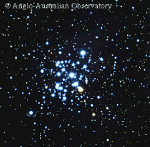 NGC 3293: A Bright Young Open Cluster
29.03.1998
Hot blue stars shine brightly in this beautiful, recently formed galactic or "open" star cluster. Open cluster NGC 3293 is located in the constellation Carina, lies at a distance of about 8000 light years, and has a particularly high abundance of these young bright stars.
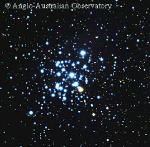 NGC 3293: A Bright Young Open Cluster
23.08.1996
Hot Blue stars shine brightly in this beautiful, recently formed galactic or "open" star cluster. Open cluster NGC 3293 is located in the constellation Carina, lies at a distance of about 8000 light years, and has a particularly high abundance of these young bright stars.
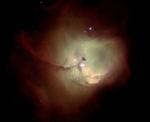 N81: Star Cradle in the SMC
5.10.2000
This dramatic Hubble Space Telescope image captures the birth of a cluster of massive stars. The newborn stars are seen just as they emerge from their natal nebula. Only 12 light-years across, the nebula...
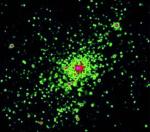 NGC 3603: X-Rays From A Starburst Cluster
24.01.2001
A mere 20,000 light-years from the Sun lies the NGC 3603 star cluster, a resident of the nearby Carina spiral arm of our Milky Way galaxy. Seen here in this recent false-color x-ray...
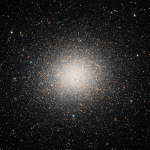 Millions of Stars in Omega Centauri
24.08.2019
Globular star cluster Omega Centauri, also known as NGC 5139, is some 15,000 light-years away. The cluster is packed with about 10 million stars much older than the Sun within a volume about 150 light-years in diameter.
 Blue Stragglers In NGC 6397
22.06.2000
In our neck of the Galaxy stars are too far apart to be in danger of colliding, but in the dense cores of globular star clusters star collisions may be relatively common. In fact...
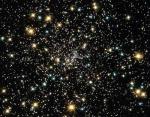 Blue Stragglers in NGC 6397
8.08.2003
In our neck of the Galaxy stars are too far apart to be in danger of colliding, but in the dense cores of globular star clusters star collisions may be relatively common. In fact...
 APOD: 2025 July 19 Б Messier 6
19.07.2025
The sixth object in Charles Messier's famous catalog of things which are not comets, Messier 6 is a galactic or open star cluster. A gathering of 100 stars or so, all around 100 million years young, M6 lies some 1,600 light-years away toward the central Milky Way in the constellation Scorpius.
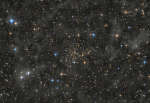 APOD: 2026 May 13 Б NGC 188: Old Cluster in the New General Catalog
13.05.2026
The New General Catalog of star clusters and nebulae really isn't so new. In fact, it was published in 1888 - an effort by J. L. E. Dreyer to consolidate the work of astronomers William, Caroline, and John Herschel along with others into a useful single, complete catalog of astronomical discoveries and measurements.
|
January February March April May June July August September |
|||||||||||||||||||||||||||||||||||||||||||||||||