
|
You entered: north star
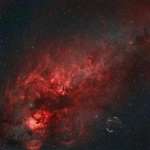 Nebulae in the Northern Cross
18.11.2010
Explore a beautiful and complex region of nebulae strewn along the plane of our Milky Way Galaxy in this widefield skyscape. The image emphasizes cosmic gas clouds in a 25 by 25 degree view centered on the Northern Cross, the famous asterism in the constellation Cygnus.
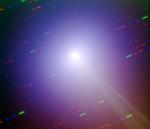 A Brighter Comet LINEAR
25.06.2001
Brighter than ever expected, comet LINEAR -- you know, the one designated C/2001 A2 -- is a sight to see in southern skies. This comet LINEAR first brightened impressively in late March as its active nucleus began to fragment, prompting some speculation that the comet might soon break up completely.
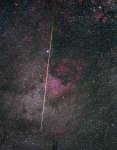 Lyrid Meteor Streak
22.04.2020
Earth's annual Lyrid Meteor Shower peaked before dawn yesterday, as our fair planet plowed through debris from the tail of long-period comet Thatcher. In crisp, clear and moonless predawn skies over Brown County...
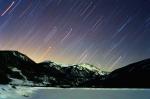 Orion Rising
24.12.2002
Orion always comes up sideways ... and was caught in the act earlier this month by astronomer Jimmy Westlake, stargazing eastward over the Rocky Mountains north of Leadville, Colorado, USA. To make this gorgeous image, Westlake placed his camera on a tripod for two exposures.
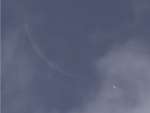 Moon and Morning Star
24.04.2009
Wednesday, the Moon and Venus rose together in early morning skies. Even through clouds, both show off a lovely crescent in this well-composed skyscape from Rutherford College, North Carolina, in the eastern US. Farther west, North American skygazers could also witness the Moon passing in front of Venus.
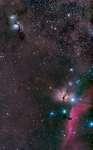 Orion s Belt Continued
10.02.2009
Yesterday's skyscape featured Alnitak, Alnilam, and Mintaka, the stars of Orion's Belt. Today's also presents the easternmost belt star, Alnitak, at the bottom right of the field, surrounded by the well-known Horsehead and Flame nebulae.
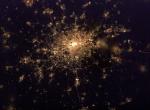 London at Night
11.04.2003
Do you recognize this intriguing globular cluster of stars? It's actually the constellation of city lights surrounding London, England, planet Earth, as recorded with a digital camera from the International Space Station. Taken in February 2003, north is toward the top and slightly left in this nighttime view.
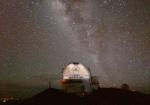 A Gemini Sky
9.09.2003
Where will Gemini take us tonight? It is dusk and Gemini North, one of the largest telescopes on planet Earth, prepares to peer into the distant universe. Gemini's flexible 8.1-mirror has taken...
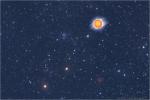 Stars and the Solstice Sun
21.06.2007
If you could turn off the atmosphere's ability to scatter overwhelming sunlight, today's daytime sky might look something like this ... with the Sun surrounded by the stars of the constellations Taurus and Gemini. Of course, today is the Solstice.
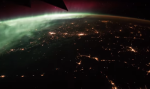 Flying over the Earth at Night II
11.03.2018
What would it be like to orbit the Earth? The International Space Station (ISS) does this every 90 minutes, and sometimes the astronauts on board take image sequences that are made into videos. The featured time-lapse video shows many visual spectacles of the dark Earth below.
|
January February March April May June July August |
||||||||||||||||||||||||||||||||||||||||||||||||||||||||